


A lead fills in a form at eleven at night and nobody calls back until Thursday, by which point a competitor who rang within the hour has already won them. That lead was never dead, just contacted too late.
Top AI voice agents close the gap between a lead arriving and a human being free to call. This Eazybe guide covers what they are, how they work, what they cost in 2026. Where they fall short and how Eazybe gets every call into your CRM.
What Is An AI Voice Agent?
An AI voice agent is software that talks to people by phone and gets something done by the end of the call. It understands normal speech, remembers what was said and can act during the conversation, such as booking a slot, qualifying a lead or updating your CRM.
The word that matters is agent. A chatbot answers questions, while an agent acts on them. So, a voice ai agent can check a record mid call, find a free slot, move the deal forward and confirm it before hanging up.
Three things separate a real voice agent from a recorded message:
- It understands normal speech, so callers can interrupt, change their mind or answer in their own words.
- It remembers the conversation, so nothing said at the start needs repeating later.
- It finishes something, whether that is a booking, a qualification or a handover to a person.
Anything that reads a script and hangs up is not an agent, however good the voice sounds.
How Do AI Voice Agents Work?
Know How AI voice agents work
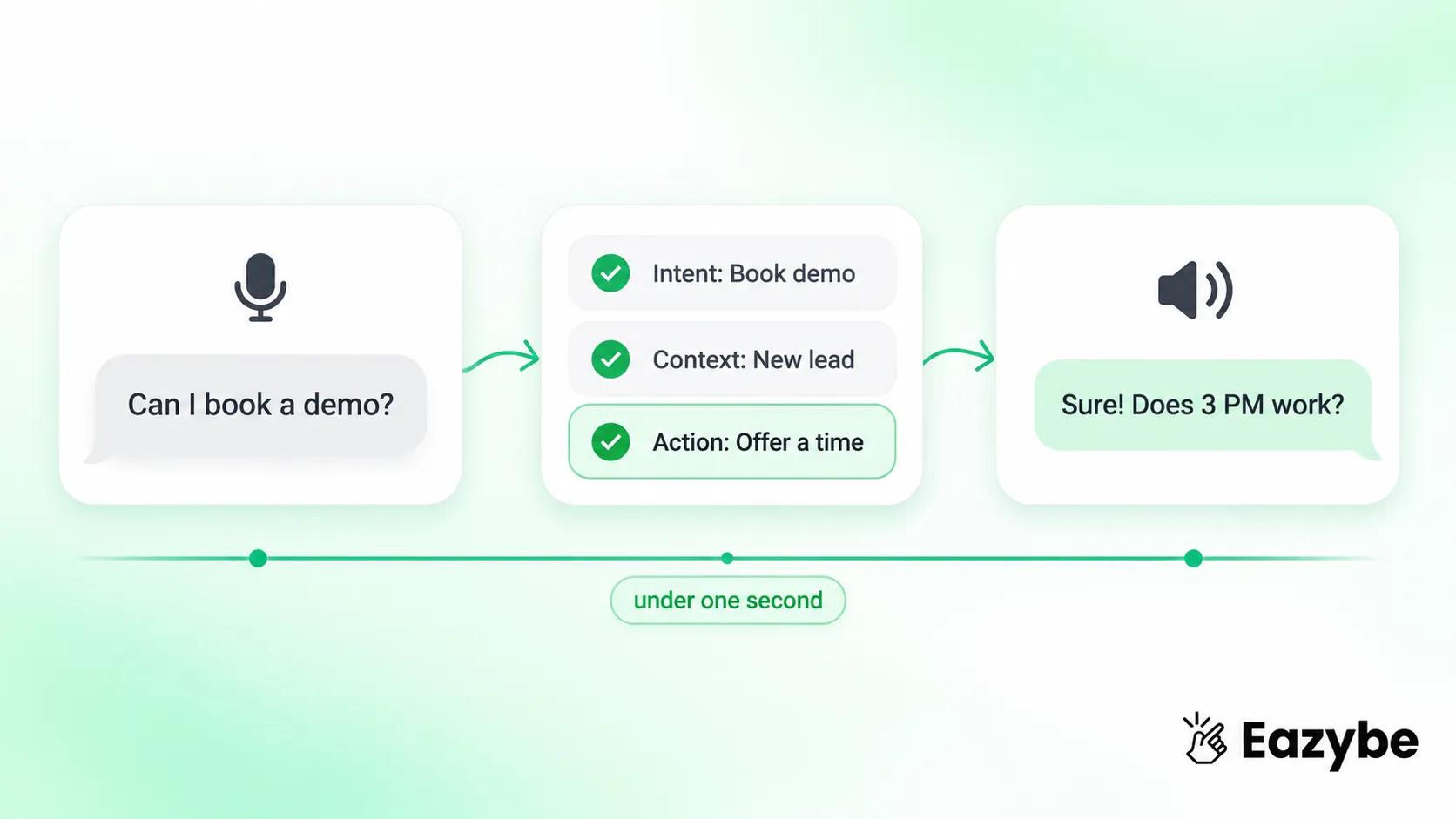
A voice agent chains three pieces together and each one has to be fast or the whole call feels broken:
- Speech to text: Turns what the caller says into words while they are still speaking, not after they finish. Everything else depends on this being right, because an agent that mishears a number has not made a small error, it has failed the call.
- The language model: Reads that text, works out what the person actually wants, checks whatever it needs such as your CRM or calendar and drafts the reply.
- Text to speech: Turns that reply into natural sounding audio.
What decides whether it feels human is turn detection, meaning how the system knows you have stopped talking. Older systems just waited for silence, Which fails constantly because people pause mid sentence while remembering a date or a number.
Modern conversational ai voice agents read pacing and tone instead. So, they sit through a hesitation but answer promptly once you are genuinely done. Keep the whole round trip under about a second and it feels like a conversation and go much above that and every caller notices.
AI Voice Agents In Numbers: What The Data Shows
The spending shift shows up clearly in the forecasts and the pattern is unusually steep for enterprise software:
- 40% of enterprise applications will embed task specific AI agents by the end of 2026, up from under 5% the year before.
- $47.5 billion market by 2034, growing from $2.4 billion in 2024 at around 35% a year.
- $80 billion in contact centre labour costs expected to come out during 2026, with roughly one call in ten automated.
- $1.18 per AI resolved interaction against $7.40 when a person handles it.
- 74% of companies report positive ROI within twelve months.
- Financial services leads adoption at just under a third of the market.
The numbers vendors rarely quote
Adoption and satisfaction are not the same thing and the gap between them is where most of the difficulty lives.
- 80% of enterprises run some form of voice agent, but only 21% are very satisfied with it.
- Trust in fully autonomous agents fell from 43% to 27% in a single year.
- Over 40% of agentic AI projects are expected to be cancelled by the end of 2027.
None of that argues against voice agents, it argues against handing one your entire sales process on day one.
A note on sourcing
Plenty of voice agent statistics online have nothing behind them, with claims like "a third of small businesses now use AI phone handling" tracing back to vendor blogs quoting each other. Before any number reaches your business case, open the original report.(Sources: Gartner and Market.us)
AI Voice Agents vs Traditional IVR
The difference is simple: IVR sends you through a menu to reach a person, while an AI voice agent understands normal speech and finishes the task itself. IVR moves the call along, an agent completes it.
Anyone who has shouted "representative" into a phone already knows the frustration and the real gap is not politeness, it is what the system can actually get done without help.
| Features | Traditional IVR | AI Voice Agent |
|---|---|---|
| Input | Keypad presses and fixed commands | Natural speech in the caller's own words |
| Flow | A menu tree that never changes | Multi turn conversation with memory |
| What it achieves | Routes you to someone else | Resolves the task end to end |
| Personalisation | Everyone hears the same menu | Pulls the account and history |
| Interruptions | Ignores them | Stops and listens |
| Updates | Needs reprogramming | Changes when you change the prompt |
The useful way to think about ai voice agents for crm vs traditional ivr is that IVR is a switchboard while an agent is a colleague. One moves the call along, the other finishes it.
Inbound vs Outbound AI Voice Agents
Inbound voice agents answer calls coming in. While outbound voice agents place the calls themselves. Inbound is easier because the customer dialled you and outbound is where sales teams need help but, where the legal and practical obstacles sit:
- Inbound agents: handle calls already arriving, so consent is implicit, the intent is usually clear and the job is mostly resolved quickly.
- Outbound agents: do the harder work of new leads, quiet deals, renewals and collections. Nobody asked to be called. So, consent becomes a legal requirement rather than an assumption and answer rates drop sharply when the number is unfamiliar.
That is why so many platforms quietly support inbound only and why "which ai voice agents support outbound phone calls" keeps getting asked with so few straight answers. An outbound ai voice agent that ignores consent is not a product, it is a liability waiting to arrive.
How Outbound AI Voice Agents Get Consent Before Calling
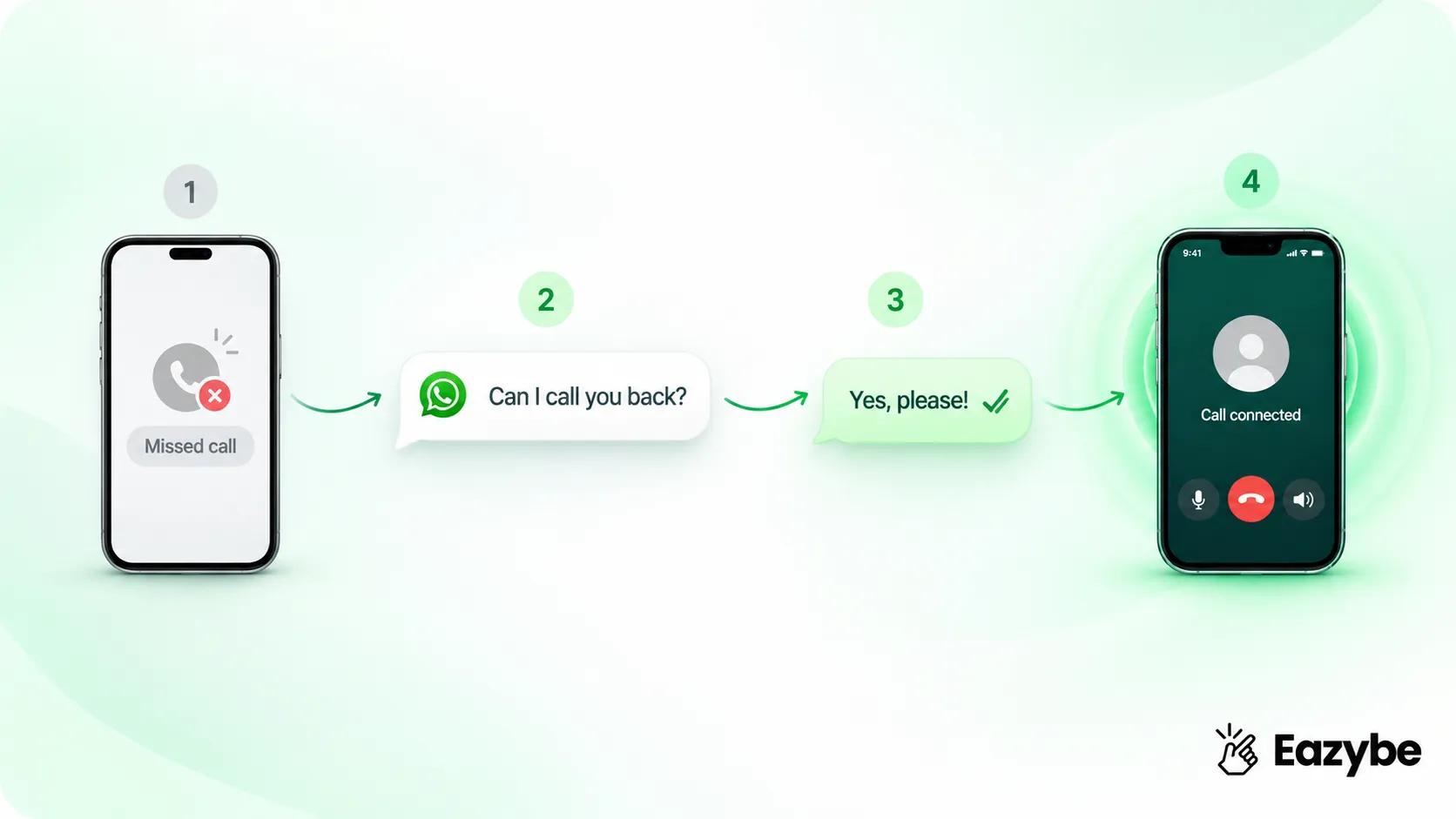
AI voice agent consent before every call
Regulators in several markets already treat AI generated voices as artificial or pre-recorded, which means marketing calls usually need prior express consent rather than a legitimate interest argument.
That sounds like a blocker and it is closer to a design brief, since the cleanest way to get consent is to ask for it on a channel the person already uses every day.
Here is how a consented outbound flow runs:
- A missed call goes out from your business number, costing nothing and creating no obligation.
- At the same moment a WhatsApp message arrives, asking whether now is a good time to talk.
- If the person replies yes, the agent calls back and the conversation starts.
- If they ignore it or decline, no call is placed and no rule is broken.
The trade off is worth stating plainly. You reach fewer people than a system that dials everyone and the ones you do reach have actively agreed to speak, which changes the tone of the whole call because nobody is annoyed at being interrupted when they picked the moment themselves.
Anyone doing outbound in a regulated market should also understand how WhatsApp treats unsolicited contact, which is covered in will WhatsApp ban my number for marketing.
Benefits Of Top AI Voice Agents
The main benefits of AI voice agents are speed, coverage and consistency. They contact leads the moment an enquiry arrives, handle many conversations at once, ask the same qualifying questions every time and log every call automatically. So, reps spend their hours on conversations that are already warm:
- Speed to first contact: a lead arriving at midnight gets a conversation at midnight, not on Thursday.
- No missed calls at peak: fifty simultaneous conversations are no harder than one.
- Every call was handled the same way: no rep having a bad morning, no skipped qualifying question.
- Voice cuts through when text does not: plenty of people ignore messages but will talk for two minutes.
- Cold lists become workable again: an old database can be called without hiring anyone.
- Reps only get warm conversations: the agent absorbs the unqualified and passes on the rest.
- Complete records by default: every call transcribed, summarised and logged with nobody typing.
- More than one language: the same agent switches without a bilingual hire.
- Costs stay flat as volume rises: doubling calls does not mean doubling headcount.
- Managers see what actually happened: the transcript exists, so coaching rests on evidence.
That last point is underrated, since most sales managers have never heard the majority of calls their team makes and end up coaching on what reps report rather than what they actually said.
Cons Of AI Voice Agents: What They Cannot Do
The main limits of AI voice agents are accents and background noise, complex negotiation and the setup work nobody budgets for. They also cannot dial freely, since consent rules restrict outbound and they should hand over to a person the moment a caller asks for one:
- Accents and noise still break them: A caller on a building site or with a strong regional accent gets misheard more often than any vendor demo suggests.
- Consent limits reach: Doing outbound properly means calling fewer people and anyone promising unlimited dialling is ignoring the law.
- They lose complex negotiation: Price pushback, a frustrated existing customer, anything needing judgement, all of it belongs with a human.
- Setup is real work: The prompt has to reflect your actual products, pricing and objections and the first version is never the one you keep.
- People still want a human: A caller who asks for a person should get one immediately and an agent that resists will cost you the relationship.
- Details go wrong under pressure: Emails, account numbers and dates are where errors cluster, so confirm anything critical by message afterwards.
- It cannot rescue a bad offer: If nobody wants what you sell, calling faster only speeds up the rejection.
The teams that succeed narrow the job down, read the transcripts and escalate early, while the ones that fail hand over the whole sales process on day one.
Best AI Voice Agents For Lead Qualification
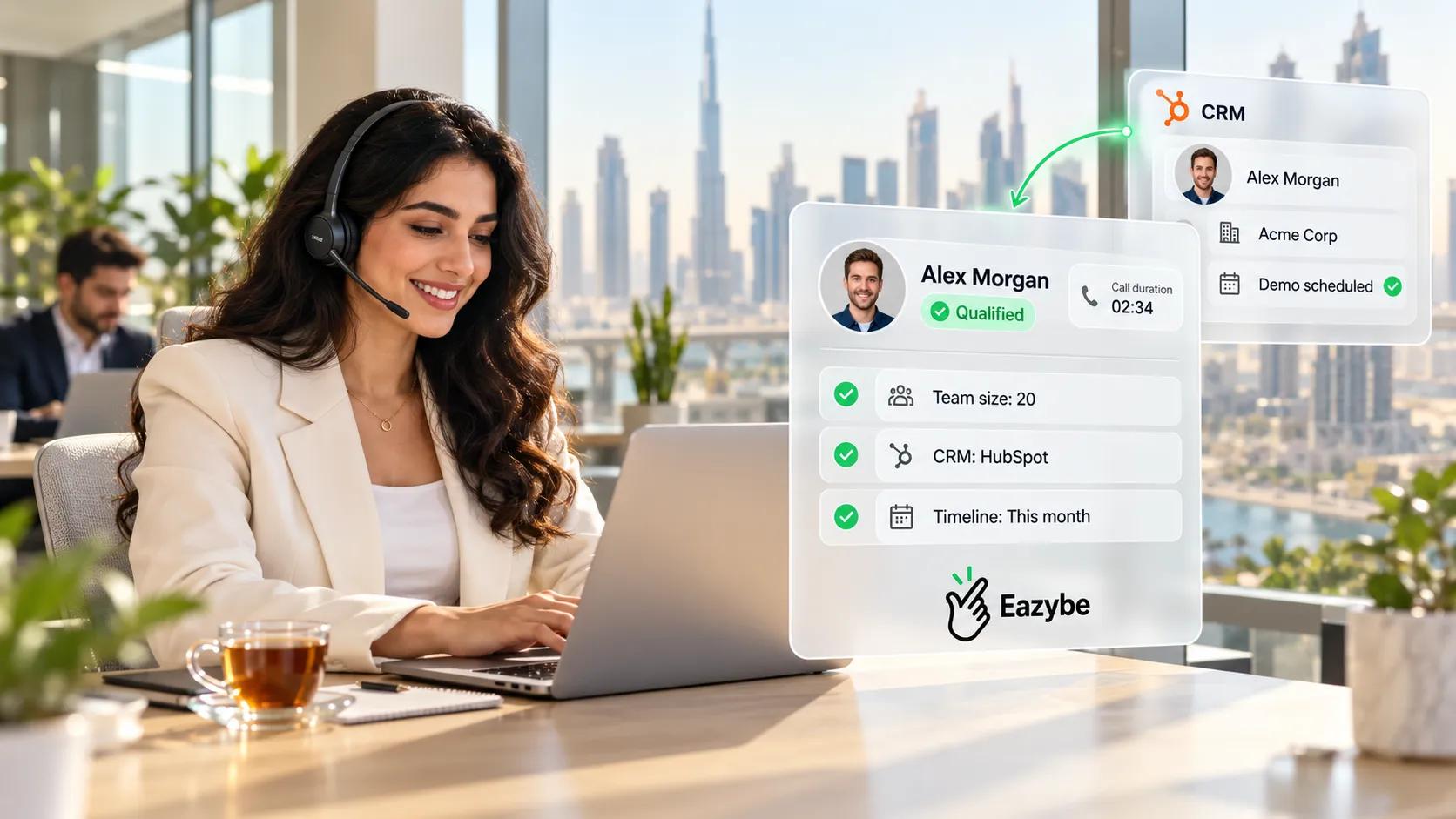
AI voice agent leads qualified, CRM updated
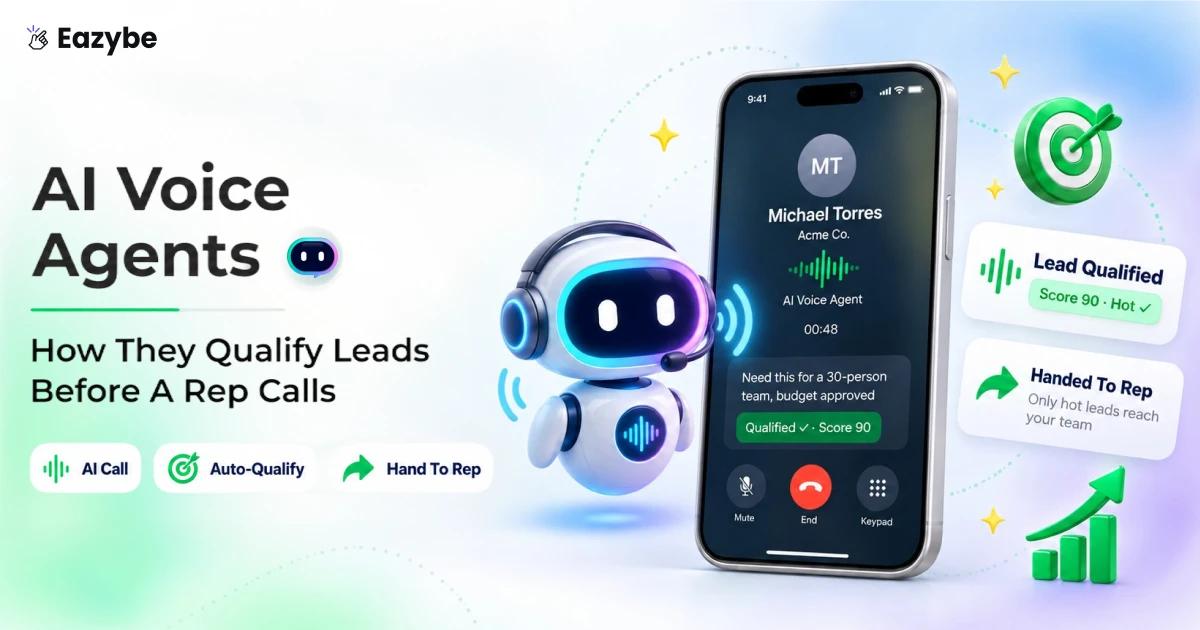
Advance AI voice agents qualify leads by calling them, asking your qualifying questions, scoring the answers against your rules, booking the next step and writing everything back to the CRM. The rep then opens a record that already holds the answers instead of starting from nothing.
A reliable AI voice agent for lead qualification will:
- Confirm the person is who the form said they are.
- Establish what they actually want, in their own words.
- Check budget, timeline and decision authority as far as the conversation allows.
- Score the lead against your rules rather than a generic template.
- Book the next step straight into a rep's calendar.
- Hand over immediately when someone is clearly ready to buy.
- Write the outcome and full transcript back to the CRM.
Where an ai voice sales agent differs from a support bot is the goal, since support optimises for closing the ticket while sales optimises for finding the few conversations worth a human hour.
AI Voice Agent Lead Warming: Benefits For Sales Teams
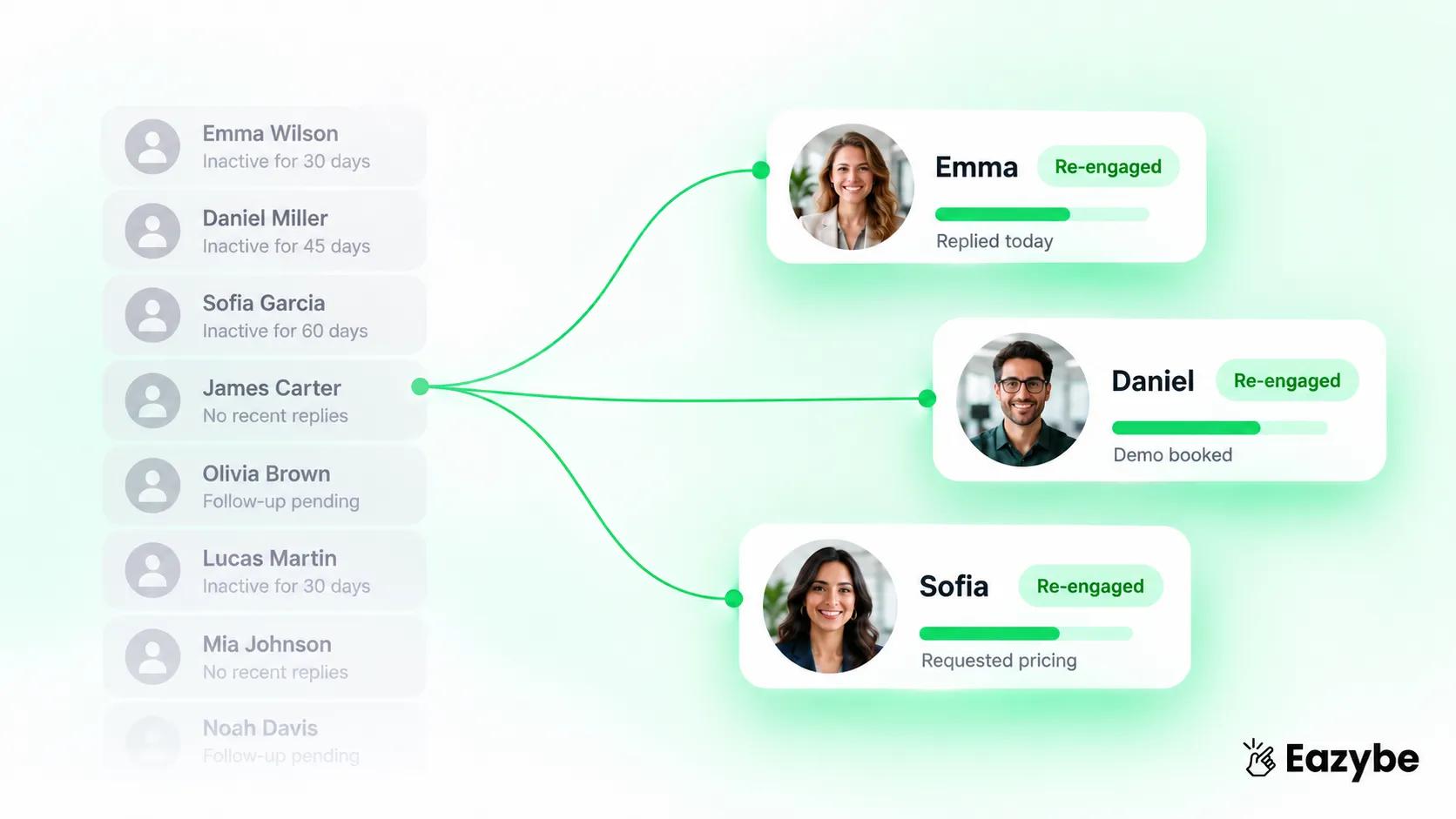
AI voice agent Cold leads re-engaged automatically
Lead warming means calling leads who went quiet to see who has come back into the market. A voice agent can work that list steadily at almost no marginal cost, which is why it often produces the fastest return of any voice agent use case.
Every business has this list. People who were interested, something stalled and nobody has called since. Reps avoid it because the hit rate is low and the rejection is demoralising, so it sits untouched while the team buys new leads at a higher price.
The best ai voice agent lead warming benefits that matter most:
- Old databases start producing pipelines again at almost no extra cost.
- Reps never spend a morning on a list with a two percent hit rate.
- Renewals and repeat purchases get contacted on time rather than when someone remembers.
- Changed circumstances get spotted, such as a budget freeing up next quarter.
How To Use An AI Voice Agent: A Working Setup
To use an top notch AI voice agent, pick one narrow job, write a prompt covering your products and objections, set clear handover rules, connect your CRM before launch, test on twenty leads and read every transcript, then scale. The whole sequence takes days rather than months.
- Pick one job first: Not "handle sales", but something like "call every inbound web lead within five minutes and book the qualified ones".
- Write the prompt like you are training a new starter: What you sell, what it costs, the three questions that separate a buyer from a browser, the two objections you hear weekly and what to say when it does not know.
- Set handover rules explicitly: Ready to buy, asks for a person, sounds annoyed, mentions a competitor, all of it goes to a human.
- Connect the CRM before launch, not after, or you spend a month with outcomes sitting somewhere nobody looks.
- Run twenty leads and read every transcript: You will find three things the prompt got wrong, which is the whole point of a small batch.
- Then scale and keep reading a sample: weekly at first and monthly once it settles.
Connecting the agent to whichever CRM you already run is covered across the integrations pages.
All In One CRM And AI Voice Agents For Businesses
An all in one setup means the voice agent writes directly into your CRM rather than its own dashboard. The call outcome updates the deal, the transcript attaches to the contact, the qualification answers fill fields and the next task is assigned automatically.
Without that, the failure is predictable. The agent makes 400 calls, the outcomes live in the voice platform, the CRM still shows those leads as untouched and a rep phones someone who spoke to the agent yesterday.
What changes when the two are joined:
- The call outcome updates the deal stage on its own.
- The transcript attaches to the contact record and stays searchable months later.
- Qualification answers populate fields rather than sitting in a note.
- The next task is created and assigned to the right person.
- Reporting covers voice, messaging and pipeline in one place.
This is also the practical answer to how to integrate ai voice agents into existing systems, since the integration is rarely hard technically but always decides whether the agent is useful or just another silo.
List Of AI Voice Agents By Industry: Where They Are Used
Every industry uses voice agents for the same core job, which is handling the first conversation so a human only picks up the ones worth their time. The details differ by sector and these are the places they are being deployed most.
- AI voice agents for real estate: qualifying property enquiries and booking site visits.
- AI voice agents for healthcare: patient appointment scheduling, reminders and follow ups.
- AI voice agents for patient appointment scheduling: cutting no shows with confirmation calls.
- AI voice agents for dental practices: filling cancelled slots and recall appointments.
- AI voice agents for customer service: resolving routine queries before they reach a human.
- AI voice agents for customer support: triaging tickets and escalating the complex ones.
- AI voice agents for restaurants: taking bookings and handling order calls at peak hours.
- AI voice agents for financial services: verification, collections and policy renewals.
- AI voice agents for HR and recruitment: screening candidates and scheduling interviews.
AI Voice Agents For Omnichannel Customer Engagement
Omnichannel means the call, the messages and the CRM record form one thread rather than three systems. The agent knows what was discussed before it dials and a rep opening the record sees calls and chats in sequence instead of switching tabs.
The problem it solves is familiar. A customer messages on Monday, takes a call on Wednesday and replies again on Friday and if those live in separate systems the Friday reply arrives with no memory of Wednesday.
Proper ai voice agents for omnichannel customer engagement keep one thread:
- The voice conversation sits in the same history as the messages.
- The agent knows what was already discussed before it dials.
- A rep sees calls and chats in sequence rather than in two tabs.
- Follow ups go out on whichever channel the customer actually answers.
Voice works best as another turn in an existing conversation rather than a cold interruption, which is exactly why pairing it with messaging outperforms pure dialling.
What Is The ROI Of An AI Voice Agent?
The ROI of an AI voice agent comes from three places: coverage, meaning leads contacted that previously were not, speed, meaning first contact in minutes rather than days and time reallocation, meaning reps stop filtering and start selling. Coverage is usually the largest and the least forecast.
- Coverage: Leads that arrived at night, at the weekend or on a busy day now get a conversation instead of nothing.
- Speed: Reaching someone in minutes rather than days changes the conversion rate, especially where buyers contact several suppliers at once.
- Time reallocation: The saving is not fewer people, it is the same people spending their hours on deals rather than filtering.
A worked example: A team getting 1,000 leads a month currently reaches around 400, because two reps can only dial so much. A voice agent contacts all 1,000 through the consented flow and passes on the qualified ones, so the reps end the month with more real conversations while making fewer total calls.
Run that with your own numbers, meaning leads per month, current contact rate, average deal value and close rate. If the payback is not obvious in the first calculation, the use case is probably wrong.
How Much Does An AI Voice Agent Cost In 2026?
AI voice agents are priced three ways: per minute of talk time, bundled into a monthly or per seat platform fee, or built yourself from components. Per minute suits low volume, bundled is cheaper at scale and building it yourself hides the cost in engineering time:
- Per minute pricing: charges for talk time and gets expensive quickly once volume grows.
- Bundled platform pricing: wraps everything into a monthly or per seat fee with a credit allowance, which is easier to budget.
- Build it yourself: looks cheap on component cost and rarely is once engineering time is counted.
The costs people forget:
- Telephony charges, billed separately from the AI on most platforms.
- Failed and unanswered calls, which still consume resources on some pricing models.
- Setup and prompt development, whether paid to the vendor or absorbed internally.
- Ongoing tuning, since an agent left alone for six months drifts out of date with your pricing.
Ask any best AI voice agent platform for the total cost of a thousand completed conversations rather than a per minute rate, because that is the only figure you can compare fairly.
What To Look For In An AI Voice Agent Vendor
Ask any vendor eight things: whether outbound is supported and how consent works, whether it writes to your CRM natively, how escalation happens, which languages it really handles, whether you can read every transcript, who owns the data, what it does when it does not know and the price at your volume:
- Outbound and consent: If the answer is vague, walk away.
- Native CRM write back: or does it need a developer and a webhook?
- Escalation speed: How quickly can a human take over the live call?
- Real language coverage: including the accents in your market rather than the language list on the site.
- Full transcripts: or only the summary the platform chooses to show you?
- Data ownership: Who holds the recordings and where are they stored?
- Behaviour when it does not know: A good agent says so and escalates, a bad one invents an answer.
- Price at your actual volume: not the tier printed on the pricing page.
The vendors worth trusting answer these directly and anyone treating a trusted ai voice agent provider conversation as a pitch rather than a technical discussion is telling you something.
Which AI Voice Agent Is Best For Small Businesses?
For a small business, the best AI voice agent is a bundled tool priced per seat with a native CRM connection, not an infrastructure platform aimed at developers. Small teams need something working within days, without an engineer to assemble the pieces.
What changes at small scale:
- Nobody has an engineer to spare, so anything requiring orchestration is out.
- Volume is too low to justify per minute pricing with a large minimum.
- One person handles sales, support and follow up, so a single purpose agent misses the point.
- The CRM is probably HubSpot, Zoho or a spreadsheet and the agent must work with that as it is.
So, the right ai voice agent solutions for a small team are bundled rather than assembled, priced per seat and connected to the CRM out of the box. The infrastructure platforms dominating search results for this topic are excellent products built for developers and almost never right for a five person team.
Why Eazybe Is The Best AI Voice Agent For Sales Teams
Eazybe is built for sales rather than support. It runs on your WhatsApp API number, gets consent before dialling, reuses the prompt from your text agent and writes the transcript and outcome straight into HubSpot, Salesforce, Zoho, Pipedrive or Bitrix24.
- It calls from a number customers recognise: since it runs on the WhatsApp API number they already message rather than an unknown line nobody answers.
- It gets consent before it dials: A missed call goes out alongside a WhatsApp message and the conversation only happens if the person agrees, which is compliant by design.
- It uses the prompt you already wrote: so a team that has trained a text agent on its products and objections is not starting over.
- Everything lands in the CRM: with qualification answers filling fields rather than sitting in a note nobody opens.
- Handover carries the history: so the rep sees the whole conversation and the customer never explains themselves twice.
- Voice and messaging stay in one thread: because the call, the follow up and the reply belong to the same conversation.
The text agents that run on the same prompt are covered on the AI sales agents page.
How To Create An AI Voice Agent Without Code
You can create an no code AI voice agent in six steps: choose one workflow, write what the agent needs to know, set escalation triggers, connect your CRM, test on a small batch and read every transcript, then scale while reviewing a sample weekly.
- Choose the single workflow: whether that is new inbound leads, cold list revival or renewal reminders.
- Write what it needs to know: meaning products, prices, qualifying questions, objections and the limits of what it should discuss.
- Set escalation triggers generously: since over escalating costs a rep five minutes while under escalating costs you a customer.
- Connect the CRM: so outcomes and transcripts have somewhere to go from the very first call.
- Test on a small batch and read every transcript: fix the prompt, then run another batch.
- Scale, then review a sample weekly: until the outputs stop surprising you.
The whole sequence takes days rather than months and step five is the one people skip and later regret.
How To Measure AI Voice Agent Performance
Measure an AI voice agent on connect rate, completion rate, escalation rate, qualified leads per hour, cost per qualified lead and the conversion rate of the leads it passes on. That last one is the honest test, since qualified leads that never close were never qualified.
- Connect rate: what share of attempts became a real conversation.
- Completion rate: how often it finished the task rather than stalling.
- Escalation rate: too high means it cannot cope, too low means it should be escalating more.
- Qualified leads per hour: whether it genuinely beats a human at this job.
- Cost per qualified lead: the only fair comparison against your other channels.
- Conversion of agent qualified leads: whether the ones it passes on actually close.
- Average handling time: useful as a trend rather than a target.
Vendors report call volume because it flatters them and none of these numbers do.
Legal And Compliance: What You Must Get Right
Four rules hold nearly everywhere: get prior consent for marketing calls, disclose that the caller is speaking to an AI, ask permission before recording and decide where transcripts are stored and who can access them. Rules vary by country, so confirm locally.
- Consent for marketing calls: AI voices are generally treated as artificial or pre-recorded, which usually requires prior express consent. And capturing it on a messaging channel first is the cleanest route.
- Disclosure: Say plainly and early that this is an AI, because even where it is not required, customers feel deceived when they find out later.
- Recording permission: If calls are recorded, say so at the start and get agreement, since one party and two party consent rules differ widely.
- Data handling: Transcripts contain personal data, so storage location, retention period and access need deciding before you start rather than after a customer asks.
This is not legal advice, so confirm the position in each market you call into.
Are AI Voice Agents Better Than Human Agents?
No. Voice agents beat humans on volume, consistency and availability, while humans beat agents on judgement, negotiation and relationships. The teams getting real value use the agent as the first filter and give their people the conversations where being human actually matters.
An agent will make the four hundredth call of the day as carefully as the first, at three in the morning, with no break and no pep talk. What it cannot do is read hesitation, handle a frustrated customer, negotiate on price, or build the relationship that brings someone back in two years.
Treat it as the filter rather than the salesperson and it absorbs the volume that was drowning the team, which is the whole point.
Final Thoughts: Is An AI Voice Agent Right For Your Team?
An AI voice agent is right for you if three things are true: you have more leads than you can call, the first conversation follows a rough pattern and the output will reach your CRM. If any answer is no, fix that before buying anything.
- More leads than you can call? If reps already reach everyone within the hour, an agent adds cost without adding coverage.
- Does the first conversation follow a pattern? Qualification that runs to a rough script automates well, while a call that is different every time does not.
- Will the output reach your CRM? If not, you are buying a second system to check and within a month nobody will check it.
If all three are yes, start with one narrow workflow rather than the whole funnel, read the transcripts for the first fortnight and expand from what you learn.
See it working on your own leads. Eazybe's AI voice agent runs on your WhatsApp number, gets consent before it dials and writes every transcript straight into your CRM.
Start a free trial with no card required, or BOOK A DEMO and watch it qualify a real lead.