
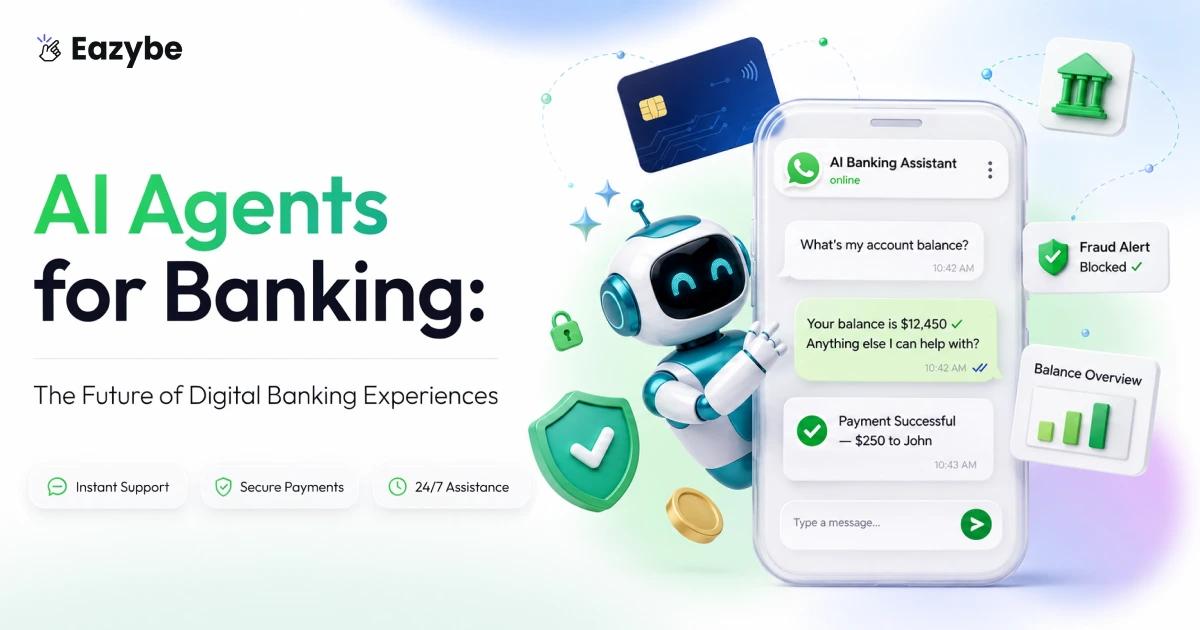


AI agents for banking are changing how banks serve people and run their daily work. Instead of leaning only on basic chatbots or slow manual steps banks now use agents that answer customer questions, handle repeat tasks flag fraud and back up staff in real time. As customers expect faster help these agents let banks reply in seconds and cut running costs and make each interaction feel more personal.
Eazybe - WhatsApp AI agents sit inside WhatsApp where people already chat and they qualify the lead clear the routine questions and pass the chat to a human the moment it matters. In this guide we cover what AI agents for banking are how they work to their main benefits, the real use cases and how banks can bring them in without the usual mess.
What Are AI Agents For Banking?
AI agents for banking are smart software systems that can read a request make a decision and finish the task with very little human help. A normal chatbot just answers a question. Rule based automation just follows a fixed path. AI agents go further. They think through a messy request to reach into more than one banking system and take real action to get the job done.
Take a card payment dispute. A chatbot might just share a help article and stop there. An AI agent checks the transaction, raises the dispute request, updates the customer on where it stands and sends the case to a bank employee if it needs a human.
These agents mix large language models, memory workflow automation and direct links into banking systems. It is what makes them useful across customer service fraud checks, loan processing account management compliance and plenty of other daily banking work. Teams running ai agents for customer support see this every day.
AI Agents vs Chatbots vs Traditional Banking Automation
Banks have leaned on chatbots and automation for years but those tools only handle set jobs they were told about in advance. AI agents move past that. They read what the customer actually means make a call and run the whole workflow instead of replying to one line at a time. Here is the plain comparison.
| Capability | Chatbot | Traditional automation and RPA | AI agents for banking |
|---|---|---|---|
| Decision making | Follows fixed scripts | Follows set rules | Reads context and adapts |
| System access | Usually limited | Works on one workflow | Connects across many banking systems |
| Learning | Limited | Does not learn | Improves through feedback and data |
| Autonomy | Waits for input | Runs one assigned task | Plans and finishes the whole task |
| Best use case | FAQs and simple queries | Repeat back office jobs | Support operations fraud and full workflows |
Why Are Banks Adopting AI Agents For Banking Now
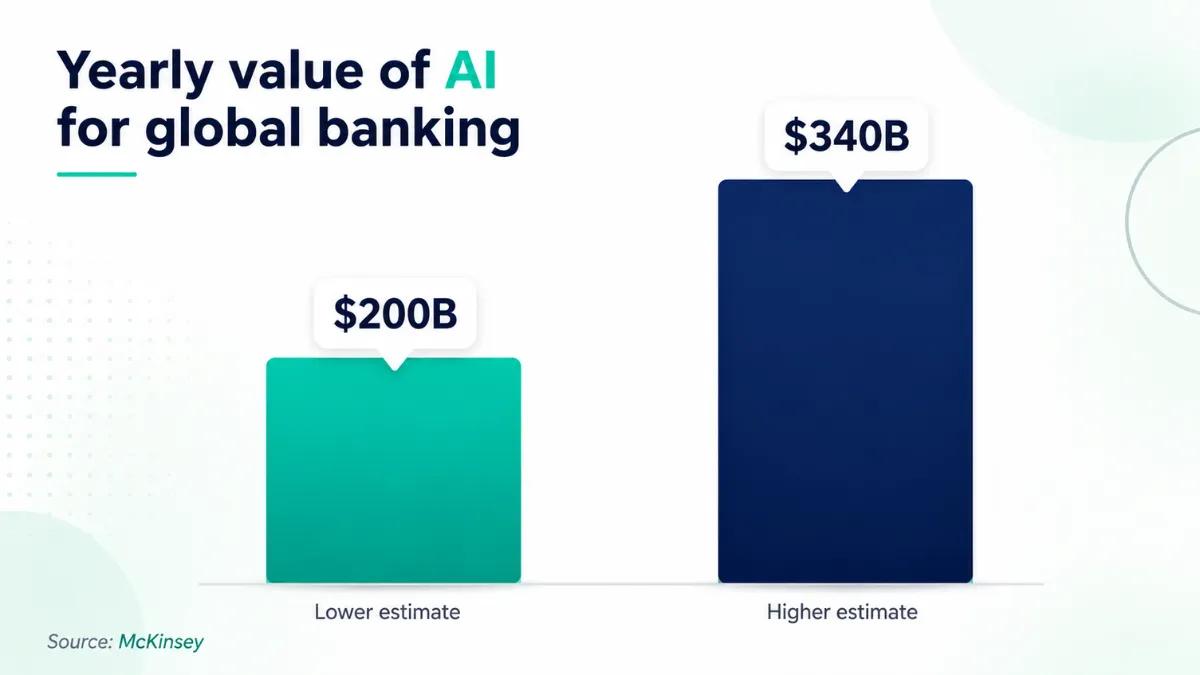
Note: AI could add up to $340B in yearly value to global banking.(Source: McKinsey)
The fast pull toward AI in banking is not about chasing a trend. It is about results. Banks are under real pressure to lift customer experience trim running costs and keep pace with digital first rivals.
McKinsey puts the yearly prize from generative AI across global banking at $200 billion to $340 billion which is close to 9 to 15 percent of operating profits. The flip side is just as sharp. Banks that drag their feet risk falling behind as customer expectations and competition keep climbing.
Customers also want faster and more personal service. Most people already use generative AI in daily life and even for money tasks so they expect the same instant help from their bank. Waiting days for a simple request or getting passed between agents no longer feels acceptable.
Fintechs pushed the bar higher still. With smooth digital journeys quick approvals and round the clock support they reset what people expect from any financial brand. To stay in the race traditional banks need technology that delivers speed without piling on cost. This is why so many teams now tie sales efficiency to service speed.
This is where AI agents for banking earn their place. They hold thousands of chats at once, run complex workflows, cut manual work and give steady support at any hour. The payoff is a better customer experience, tighter operations and lower cost to serve.
Real World Use Cases Of AI Agents For Banking
AI agents for banking are reshaping work across customer service operations compliance and fraud prevention. Rather than doing one small job they can run a full workflow which helps banks lift efficiency and give customers a smoother ride. Here is where they make the biggest dent.
1. Front office AI agents for banking
Better customer service and sales
The front office is where banks deal with customers face to face so it is one of the richest places to start. Front office AI agents for banking can:
- Answer customer questions at any hour with no long wait
- Guide new customers through account opening and onboarding
- Collect and check required documents on their own
- Qualify loan or card enquiries and send them to the right advisor
- Push payment reminders renewal alerts and follow up messages
- Give quick investment or portfolio summaries before a meeting
- Pass tricky chats to a human with the full history attached
Fast replies make a real difference you can measure. People stay engaged when help arrives at once instead of hours later. By taking the routine chats these agents also free your team to spend time on the conversations that carry real value. A shared team inbox and a connected WhatsApp CRM make that handoff clean.
2. Middle office AI agents for banking
Support for risk compliance and operations
Plenty of banking happens out of sight where getting it right matters as much as getting it fast. Middle office AI agents for banking take on that load and cut the manual effort. Common uses include:
- Reviewing documents during know your customer checks
- Watching transactions for odd or suspicious activity
- Helping compliance teams pull information and draft reports
- Routing cases that need a closer look
- Giving risk teams faster data collection and analysis
By clearing the repeat work these agents help teams move through cases quicker while keeping things consistent and cutting human error. A reliable WhatsApp chat sync keeps every record in place for the audit.
3. Back office AI agents for banking
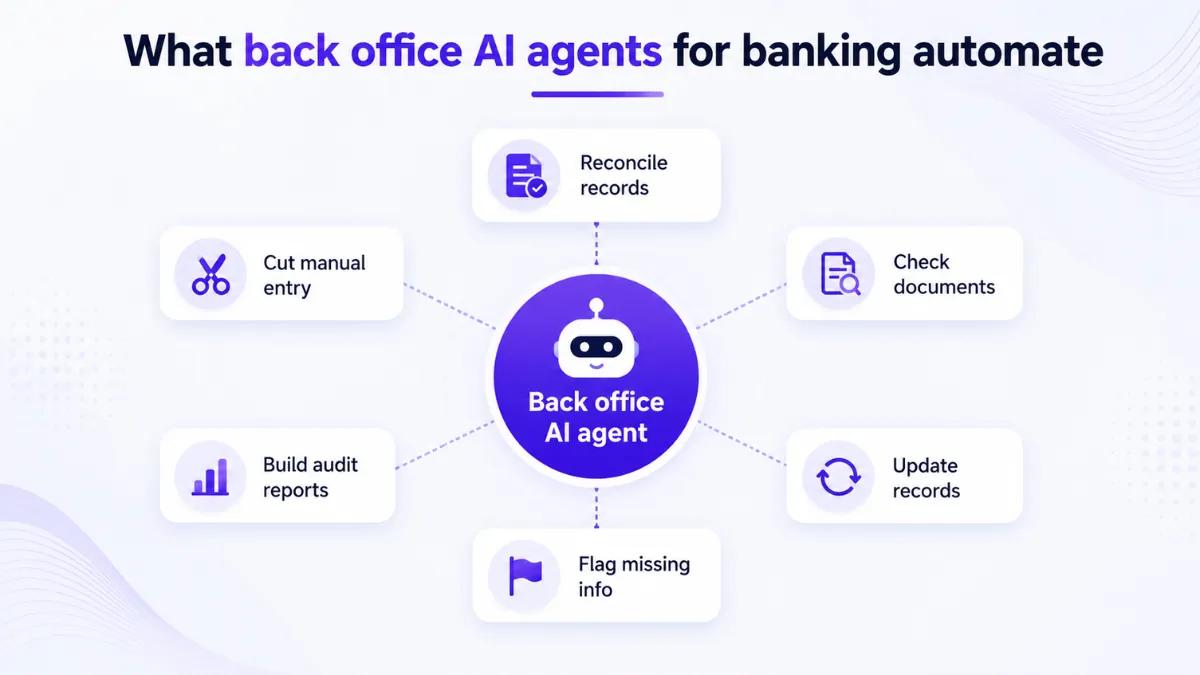
Note: AI agents help banks automate routine back-office tasks and improve efficiency.(Source: McKinsey)
Automating repeat banking workflows
Back office teams lose a lot of hours to admin. AI agents for banking take the routine off their plate. Examples include:
- Reconciling records across several systems
- Pulling and checking details from documents
- Updating customer records across internal tools
- Spotting missing information and asking for it
- Building reports for audits and internal reviews
- Cutting manual data entry across departments
Banks are leaning on AI for fraud work too. Large institutions such as JPMorgan Chase use AI to help flag suspicious transactions and support fraud monitoring in real time. Agents push this further by pulling data from many systems at once so teams can react to risk faster. A solid cloud backup keeps all of it safe and searchable.
Whether they sit in front of customers or run quietly inside operations, AI agents let banks automate full workflows, lift accuracy, lower cost and hand staff back the time to focus on higher value work.
Challenges Of Using AI Agents For Banking
AI agents can pay off in a big way but bringing them in is rarely smooth. Most banks hit a few of the same blockers before they get it right. What we hear on our own customer calls lines up closely with this list.
- Poor data quality: Agents need clean organized data to work well. Many banks still keep customer information split across systems so the agent never sees the full picture.
- Legacy banking systems: A lot of core software was never built to work with AI. Wiring an agent into it takes time and real technical effort.
- Security and compliance: Banking is tightly regulated. Every action the agent takes has to be secure, traceable and inside the rules and a human still needs to own the sensitive calls. One fintech and banking platform came to us for exactly this. Their team was on personal WhatsApp numbers so nothing was logged and compliance could see nothing.
- Customer trust: People expect quick, correct and natural replies. If the agent gets things wrong or sounds like a robot, confidence drops fast. A different fintech team spent most of a call with us just on making the agent sound like their own reps and reply without a lag.
- Lack of AI skills: Banks need people who understand both AI and banking rules and that mix is hard to hire for.
How Banks Can Overcome AI agents For Banking Challenges
The smart move is to start small. Most banks begin with plain use cases like customer support account onboarding or answering common questions. Once the agent proves its worth they widen it to heavier banking work. Many teams start with WhatsApp coexistence so staff keep their own number while the agent works beside them and a tidy HubSpot WhatsApp Integration keeps the customer record whole from day one. This step by step path lowers risk lifts customer experience and makes the whole shift far easier to manage.
How To Implement AI Agents For Banking Operations
You do not need to rebuild your whole bank to get going with AI. Most banks start with one small project, learn from it and grow from there:
- Step Check your data for AI agents for banking: Before you switch anything on make sure your customer data is correct and easy to reach. If it sits scattered across different systems connect it first. Clean data is what lets AI agents for banking give good results. Solid WhatsApp automation rests on this base being right.
- Step Start with one use case for AI agents for banking: Pick one simple task where AI agents for banking can show a clear win. Good picks are customer support account onboarding or answering common questions after business hours. Set plain goals like faster reply times or less manual work. A focused WhatsApp automation tool gets that first project live quickly.
- Step Keep human oversight for AI agents for banking: AI agents for banking should back up your team and not replace it. Let the agent handle the routine while your people manage the complex or sensitive cases. Review how the agent performs on a regular basis and keep a record of every action so you meet your security and compliance needs.
Starting small makes it much easier to test AI agents for banking, sharpen how they perform and slowly widen them across more of your operations.
Should You Build Or Buy AI Agents For Banking?
Once you know where you want to use AI the next question is whether to build your own agent or pick up a ready platform.
Building gives you full control and room to customize but it costs more time, money and technical skill. Buying a ready platform gets you moving much faster and usually brings built in integrations security and support out of the box. Many banks split the difference. They buy for the common tasks and build only when they need something truly their own.
When you compare the best ai agent platform for banks weigh these points:
- Integration: Can it connect with your core banking systems and your CRM.
- Security and compliance: Does it meet banking rules and keep a full audit trail.
- Ease of use: Is it simple for your staff to learn and run.
- Total cost: Think about setup maintenance support and ongoing usage.
- Scalability: Can it grow as your operations grow.
- Customer channels: Does it support the places your customers already are such as mobile apps web chat or messaging.
The right fit also depends on the job. Heavy regulated work suits an enterprise ai agent platform for banks with strong controls while fast customer facing wins suit a lighter tool. Teams searching the best ai agent platform for bank operations with sales enablement usually want back office strength and those after the best platforms for building ai agents in banking want open flexible APIs. A small team chasing the top ai agent for banking often just needs one channel done really well. Strong WhatsApp business tools and clear content help your team pick it up fast.
The best ai agents for banking are not always the ones with the longest feature list. They are the ones that fit your bank, match how your people work and help you give customers a better experience.
AI Agents For Banking: Data That Shows Their Impact
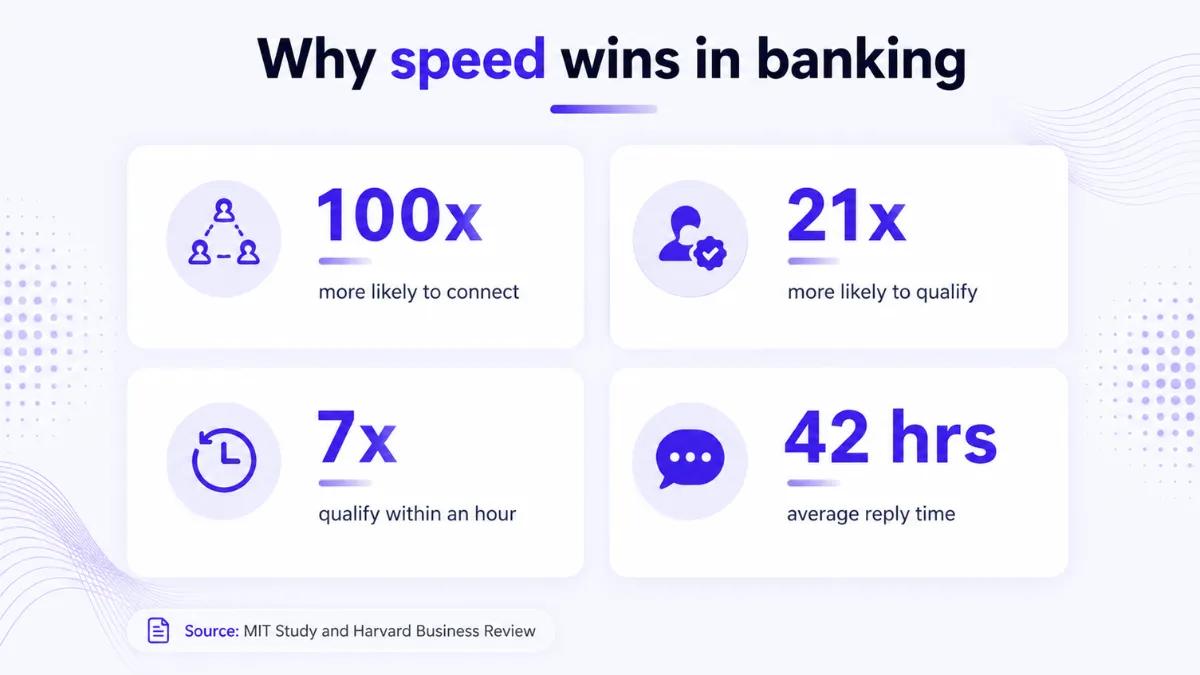
Note: Faster customer responses lead to better banking outcomes.(Source: Harvard Business Review, MIT Lead Response Management Study)
The biggest edge of AI agents for banking is speed. In banking a quick reply can be the line between winning a customer and losing one.
Research from the MIT Lead Response Management Study found that businesses are 100 times more likely to connect with a lead and 21 times more likely to qualify that lead when they reply within five minutes instead of thirty.
A separate study by Harvard Business Review found the average company takes around 42 hours to respond to a new lead. Yet the ones that replied within an hour were nearly seven times more likely to qualify that lead.
The same rule holds in banking. If someone sends a loan application or a card enquiry late at night waiting until the next working day can hand that customer to another bank. This is exactly where AI agents for banking earn their place and it is the same idea behind our AI sales agents. They reply at once, answer the common questions, collect the customer details and even book the next step all while the person is still engaged.
By pairing fast replies with automated workflows banks lift customer experience, win more leads and let far fewer chances slip away.
What Is Next For AI Agents For Banking
AI agents for banking keep getting sharper and more capable. Today they mostly help with single tasks. Soon they will run whole banking journeys from answering a question and sending a payment reminder to updating the customer record and closing the request on their own. The voice will sit next to chat and one agent will handle many languages.
Banks can get ready by starting with small projects cleaning up their data and keeping people in charge of the calls that carry risk.
The aim was never to replace staff. It is to let AI agents for banking take the routine off their plate so teams can spend their time on customers and the harder work that really needs a human.
Conclusion: Best AI Agents for Banking
AI agents for banking are changing how banks serve customers and run their day to day work. From customer support and fraud checks to onboarding and compliance they help banks move faster, cut manual effort and give people a better experience.
The best way to begin is with one simple use case. Measure what it does then widen it over time. As the technology keeps improving the banks that pick up AI agents for banking early will be the ones ready to meet rising customer expectations and stay ahead in the digital banking era.