


Eazybe - WhatsApp AI Agents make this setup work harder for you. They reply to new leads in seconds. They send the follow ups people forget. They keep the CRM updated on their own. So, your team can spend time selling instead of typing. This is worth doing now because Meta starts charging for 24 hour service messages sent through the API from October 2026. Keep normal chats on the Business App where they stay free and use the API only where you need it. Your messaging cost stays low.
This blog, covers what WhatsApp Coexistence is and how it works and why businesses are moving to it. It also covers what it does for your sales, your follow ups, your CRM visibility and your costs.
What Is WhatsApp Coexistence?
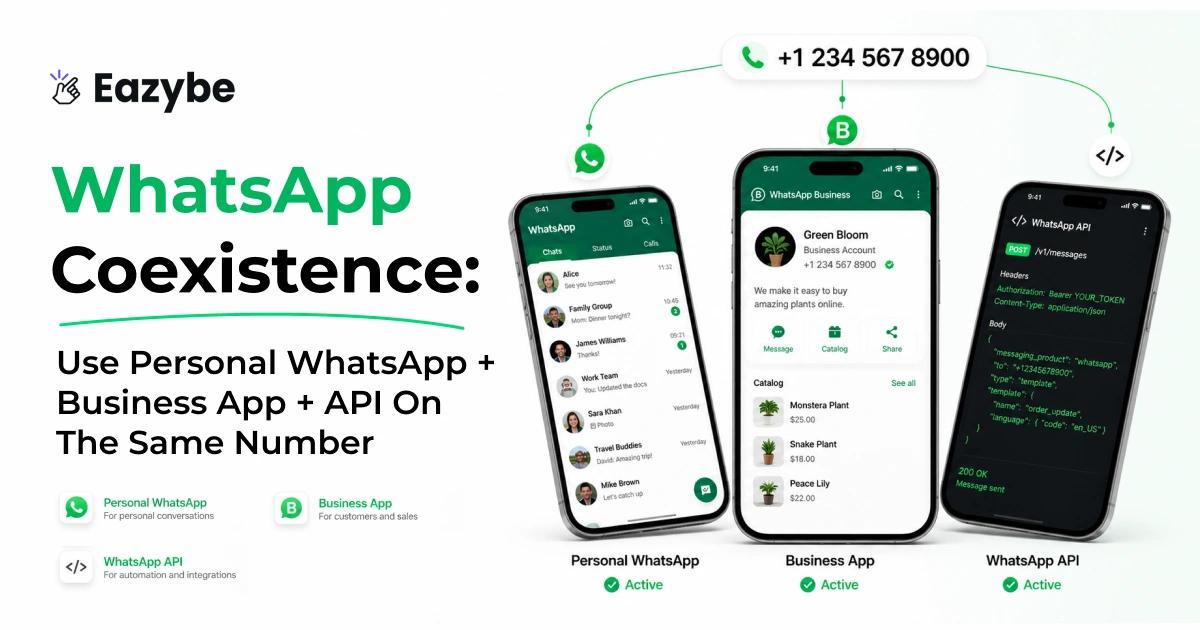
The WhatsApp Coexistence feature is official and built by Meta. It connects the WhatsApp Business App number you already use to the WhatsApp Cloud API without switching the app off. No new number. No new way of working for your team.
Earlier this was not possible. The moment a number moved to the Cloud API the Business App stopped working. Businesses had to pick one. The app or the API. Never both.
Now both run together on the same number. A message a rep sends from the app and a message sent through the API land in the same chat thread. Your customer sees one number and one conversation. They never know which side sent what.
So, you get the app and the API at the same time. WhatsApp automation and broadcasts run in the background while your team keeps chatting the way they always have. Every conversation still lands in your WhatsApp CRM so, nothing stays trapped on one person's phone. A WhatsApp Coexistence setup keeps the app and the API running side by side on one number.
Why Meta's Service Message Charges Make WhatsApp Coexistence More Important
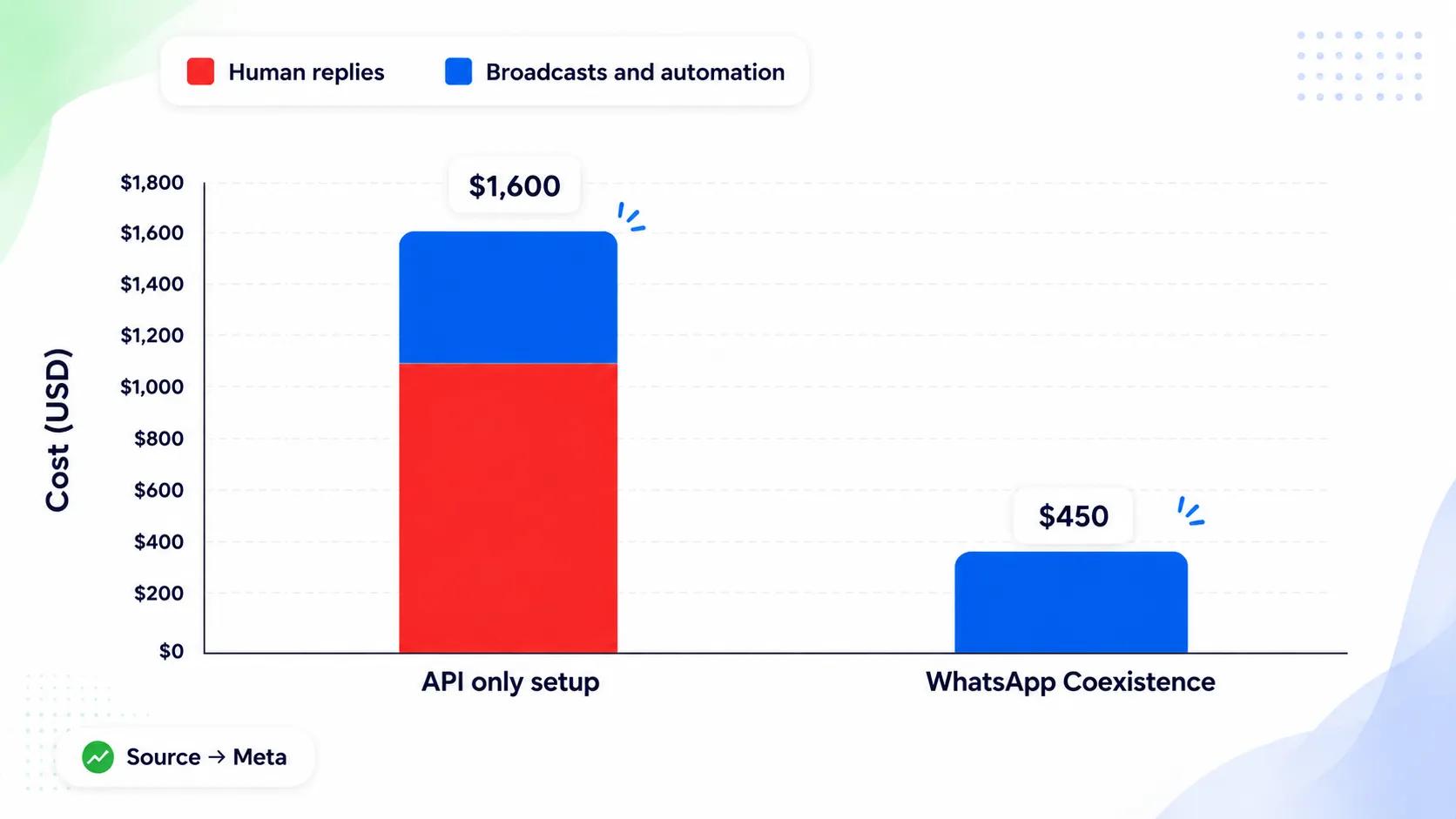
Coexistence cuts costs: human replies stay free on the app, you only pay for automation (Source: Meta)
A lot of businesses run sales and support on the WhatsApp Cloud API because replying inside the 24 hour service window was free. That is the end. From 1 October 2026 Meta starts charging for service messages again. Every reply your team or your bot sends through the WhatsApp business API Pricing inside that window now has a price on it.
Meta has also priced its Business Agent Platform where AI replies get charged on token usage. So, the more API messages and AI replies you send the higher your WhatsApp bill goes.
Coexistence pricing works differently from a full API setup. Normal customer conversations stay on the WhatsApp Business App where messages typed by a person carry no API charge. The API gets used only where it actually earns its cost, Broadcasts, Automation and CRM syncing.
Meta WhatsApp Coexistence keeps human replies on the app where they cost nothing. You keep the reporting and the sales efficiency without paying for every single human reply.
Why WhatsApp Coexistence Gives You The Best Of Both Worlds
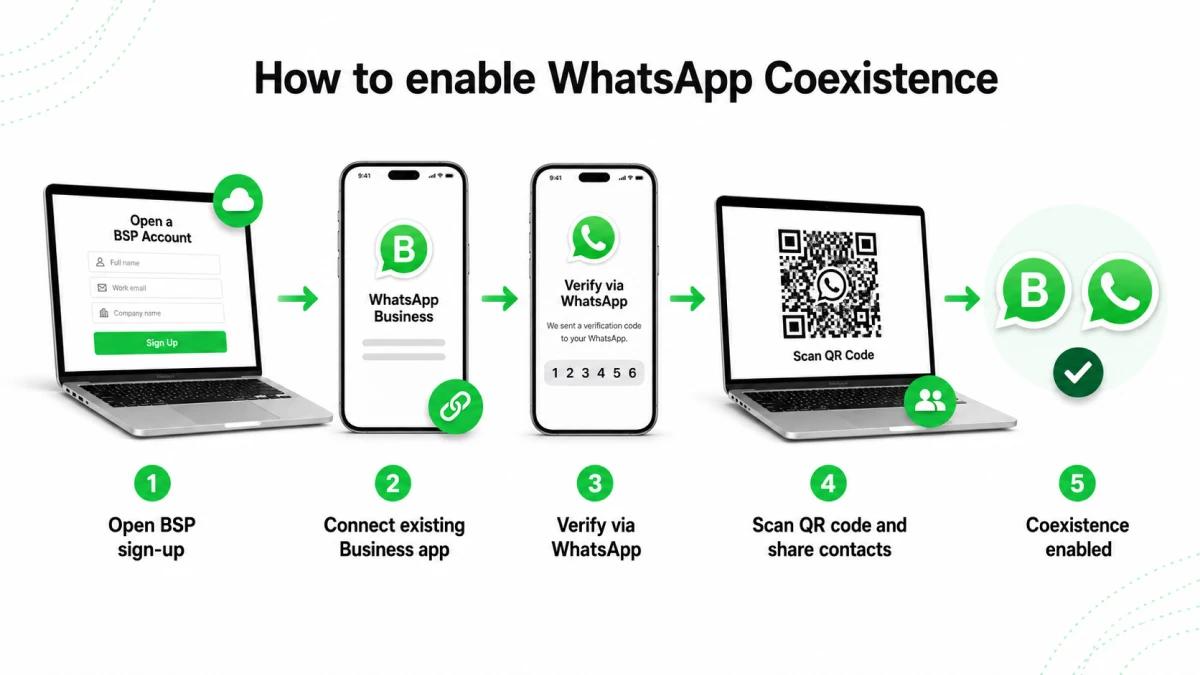
How To Enable WhatsApp Coexistence
The WhatsApp-Coex feature works on one simple idea. Let people handle conversations. Let the API handle the repetitive work.
Your sales team keeps talking to customers from the WhatsApp Business App. They send voice notes. They answer questions. They negotiate. They build trust the same way they always have. Meanwhile the Cloud API runs the boring half. Broadcasts. Payment reminders. Follow ups. The messages nobody wants to type twenty times a day.
It all happens on one number and inside one chat. So, the customer gets one clean experience. You get automation without asking anyone to change how they work. And with a WhatsApp copilot your reps get reply suggestions while they are still in the thread. So, they answer faster and closer.
WhatsApp Coexistence For Sales Teams And Lead Follow Ups
Sales teams get the most out of WhatsApp-Coex meta. Support can be automated end to end. Sales cannot. Building trust and handling objections and negotiating and closing all need a real person in the chat. That work belongs on the WhatsApp Business App.
The real problem is follow ups. Plenty of hot leads die because a rep simply forgot to check back on the right day. That is not laziness. It is a memory. Software is better at it than people are. So, let reps sell and let the API remember.
Here is what that looks like day to day:
- Reps chat with customers personally from the WhatsApp Business App.
- Hot leads get followed up automatically until they reply.
- Quote reminders and payment reminders go out on their own.
- Broadcast campaigns run from the same number.
- Every conversation syncs to the CRM so the full history sits in one place.
- Managers see response times and pending replies without chasing anyone for updates.
Your team keeps selling the way they always did. Automation just makes sure nothing gets forgotten. Set the timed nudges with a scheduler and keep common answers ready with a shared quick reply library. So, the whole team responds fast and sounds the same.
Choosing The Right Mix Of App And API In WhatsApp Coexistence
The best thing about WhatsApp Coexistence meta is that you stop choosing. You get the strengths of both on one number. Your team chats naturally with customers. While the API runs automation, broadcasts, CRM syncing and reporting behind them:
| Capability | Business App only | Cloud API only | WhatsApp Coexistence |
|---|---|---|---|
| Reply from the rep's phone | Yes | No | Yes |
| Voice and video calls | Yes | No | Yes from the app |
| Broadcasts and campaigns | Limited | Yes | Yes |
| AI replies and auto follow ups | No | Yes | Yes |
| CRM syncing and reporting | No | Yes | Yes |
| Team and manager visibility | No | Yes | Yes |
| Cost of a human typed reply | Free | Paid from Oct 2026 | Free from the app |
| Ad conversation tracking | No | Yes | Yes |
| Chat history at setup | Not applicable | No | Up to 6 months |
Look at the cost row. That is where the real difference sits. Your reps keep replying from the Business App with no API charge on those messages. The Coexistence WhatsApp API side gets used only for broadcasts and automation and AI and CRM work. You cut the bill and still get every benefit of a proper WhatsApp team inbox behind the scenes.
How Ads And AI Agents Work With WhatsApp Coexistence
This lets you run Google Ads and Meta Ads on the number your team already uses. With AI Agents on the same number your sales team already uses. Your ad opens a WhatsApp chat instead of a landing page. That is a much easier first step for a customer.
Running Google And Meta Ads On WhatsApp Coexistence
Someone taps your Google Ad or Meta Ad and lands straight in a WhatsApp chat with your business. No form. No page to load. One tap and they are talking to you.
Speed decides the rest. Make a lead wait and they are gone and you already paid for that click. AI sales agents reply in seconds. They ask two or three questions. They spot the serious buyers. Those get handed to a rep who picks up the same chat and closes it like a human being.
All of this runs on the number you already have. You do not need one number for ads and another for your team. The agent takes the first reply. The rep takes over when the conversation is worth a person. Customers get answered fast and your reps stop wasting hours on people who were never going to buy.
How AI Agents Improve Ads With WhatsApp Coexistence
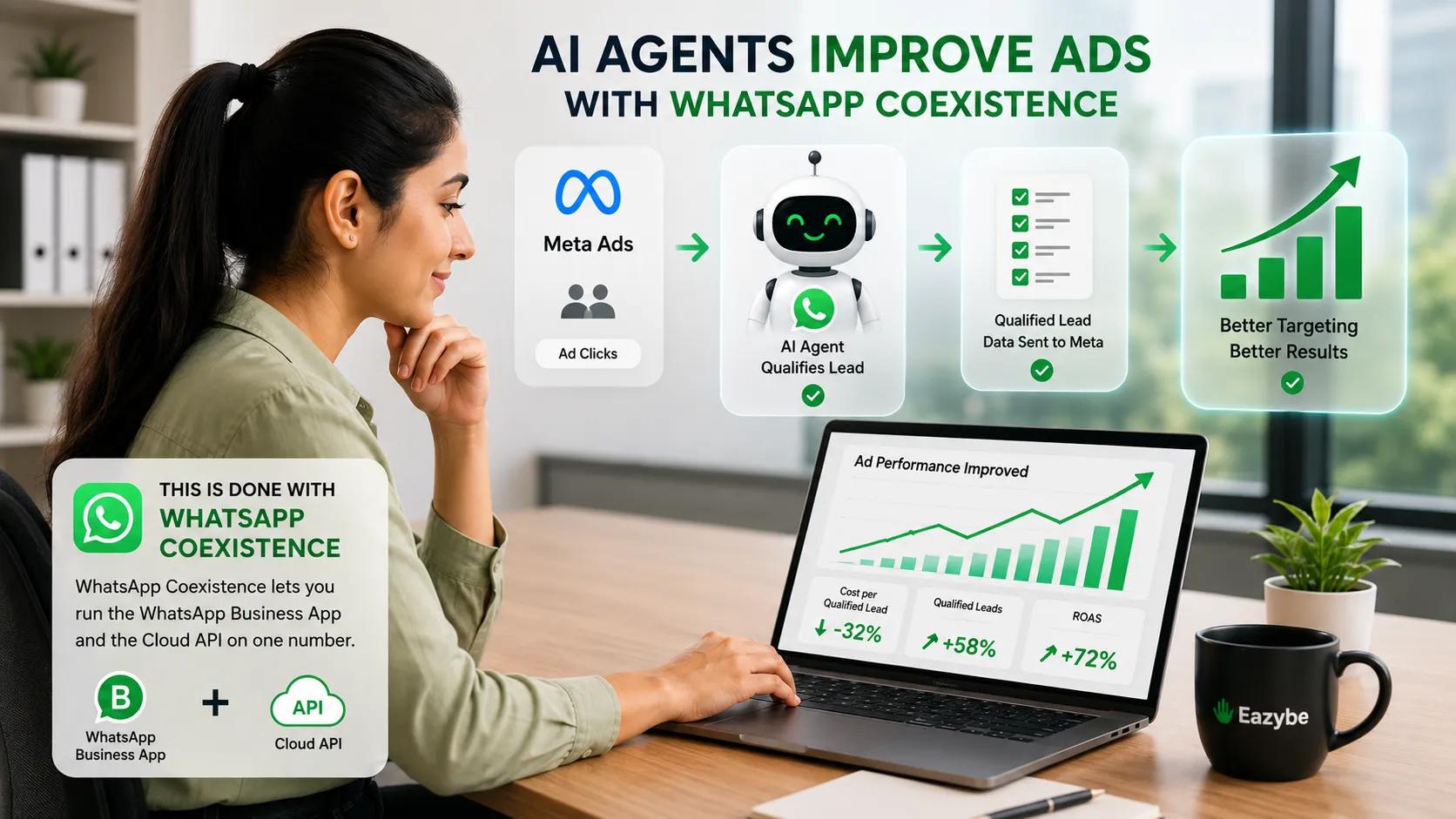
AI agents qualify ad leads and send data back to Meta
The real advantage of Coexistence is that AI Agents qualify a lead before it ever reaches your sales team. Once the lead is qualified that information goes back to Meta. So, Meta stops optimising for people who just open a chat and starts learning who turns into a real buyer.
Over the next few weeks it shows your ads to better audiences. Your cost per qualified lead falls and your campaigns start performing without you touching the creative.
With WhatsApp Coexistence you can:
- Qualify leads automatically before a rep gets involved.
- Send qualified lead data back to Meta. So, your ads optimize on real outcomes.
- Bring down your cost per qualified lead with better targeting.
- Run Click to WhatsApp Ads on the number you already use.
- Let AI Agents reply instantly while reps focus only on serious buyers.
- Keep human conversations on the WhatsApp Business App and cut your WhatsaA API cost.
- Improve your return on ad spend with proper lead qualification.
So, the loop is simple. Ads bring the leads. AI Agents filter them. Reps close them. Meta learns from the result and sends better traffic next time. Set this up properly with a good WhatsApp automation tool and your marketing gets smarter every month. While conversations stay fast and personal.
Real Business Use Cases Of WhatsApp Coexistence
The Coexistence feature works in almost any industry. Because it mixes personal conversation with automation. Here is what that looks like in practice:
- Real Estate: AI Agents qualify buyers on budget and location and property type before a rep ever sees them. The rep then continues the same chat on WhatsApp and negotiates like a human. Every conversation sits in the CRM instead of on one person's phone.
- Coaching and education: Admission season brings hundreds of parents at once. AI handles the repeat questions about courses and fees and batch timings. Counsellors step in only when someone is close to enrolling. Automated reminders stop people dropping off between the enquiry and the payment.
- Field sales and distributors. Reps keep selling from their phones while travelling. Managers still see every conversation through a shared team inbox. If a rep is unavailable the customer does not sit waiting.
- B2B sales. Long cycles get easier to manage with CRM syncing and automatic follow ups and proper WhatsApp sales funnels. Reps still chat naturally from the Business App.
- Customer support. AI agents for customer support answer the common questions instantly while your team handles the hard ones. Automating the repetitive half also keeps your API message cost down.
The pattern is the same everywhere. Automate what repeats. Keep humans where the relationship is. Let the CRM record all of it.
What Syncs And What Changes With Coexistence WhatsApp Meta
Before you turn the Coexistence WhatsApp API on it helps to know what keeps working and what does not. Tell your team this before setup. Most of the confusion afterwards comes from people finding out by accident:
What keeps working:
- One to one customer chats sync between the WhatsApp Business App and the Cloud API.
- Contacts and up to six months of chat history can be synced across.
- Voice and video calls still work from the WhatsApp Business App.
- Photos and videos and documents and other media work exactly as before.
What changes:
- Group chats do not sync with the Cloud API.
- Disappearing messages stop working in one to one chats.
- View Once media is turned off.
- Live location sharing is not available in individual chats.
- Broadcast lists in the app become read only. All broadcasts now go through the Cloud API.
- The Official Business Account blue badge is not supported on a coexistence number.
Two rules that matter most:
- Keep the WhatsApp Business App installed. Uninstall it and your setup disconnects.
- Open the app at least once every 13 days or your number gets disconnected from the Coexistence API.
Once it is running keep WhatsApp chat sync on. So, your CRM holds current conversations and not a snapshot from setup day.
Which Countries Support Meta WhatsApp Coexistence
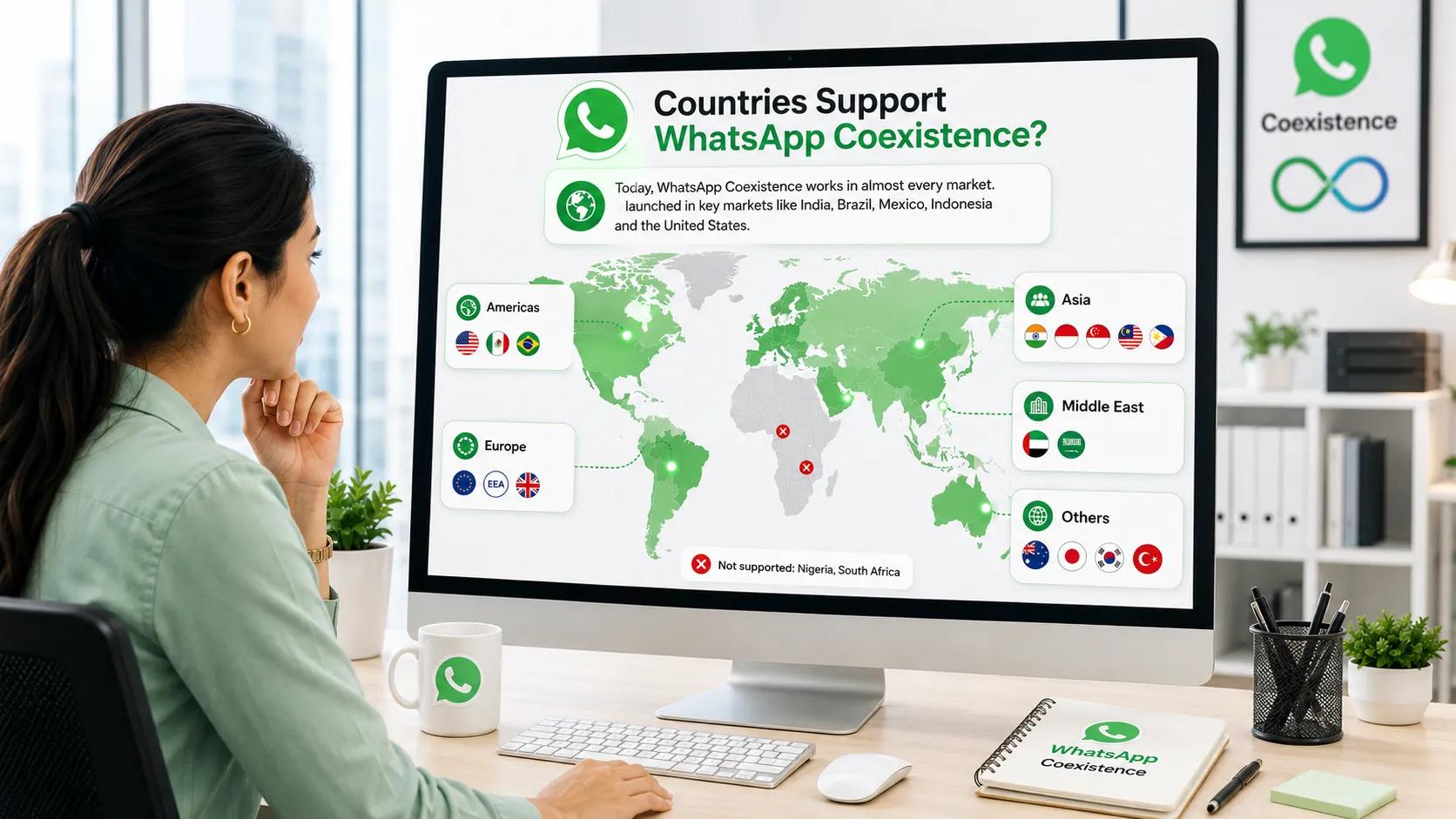
WhatsApp Coexistence works in almost every market
Today the list of WhatsApp Coexistence supported countries covers almost every market. It launched in a handful of markets like India and Brazil and Mexico and Indonesia and the United States.
Today it works almost everywhere. Meta has widened support across:
- Asia including India and Indonesia and Singapore and Malaysia and the Philippines.
- The Middle East including the UAE and Saudi Arabia.
- The Americas including Brazil and Mexico and the United States.
- Europe including the EU and the EEA and the UK.
- Australia, Japan, South Korea and Turkey.
A lot of older guides still say Europe is blocked. That is out of date. If your number works on the WhatsApp Business App then coexistence is almost certainly available to you.
Two other requirements matter as much as your country:
- Your WhatsApp Business App must be version 2.24.17 or higher.
- Your number must not already be registered on the Cloud API with another provider.
- The only country codes still excluded are Nigeria and South Africa.
Benefits Of WhatsApp Coexistence Meta
Coexistence Meta puts the Business App and the Cloud API on one number. So, you stop choosing between them. Here is what you actually get:
- One WhatsApp number running both the Business App and the WhatsApp Coexistence API.
- Your team keeps using the app while automation and CRM features run behind it.
- Lower API cost because everyday human chats stay on the Business App.
- Broadcasts and campaigns go out through the Cloud API.
- Every chat syncs to your CRM. So, customer history sits in one place.
- A shared team inbox so more than one person can handle conversations.
- Follow ups fire automatically so no lead gets forgotten.
- AI Agents qualify leads and answer repeat questions and route chats to the right person.
- Response times and pending chats and sales reports all visible to managers.
- Up to six months of past chat history synced during setup.
- Click to WhatsApp Ads run on the same business number.
- No number change and no disruption to how your team already works.
Put simply it cuts your messaging cost and cleans up your follow ups and gives your sales team the visibility they never had on WhatsApp.
How To Set Up WhatsApp Coexistence With Eazybe
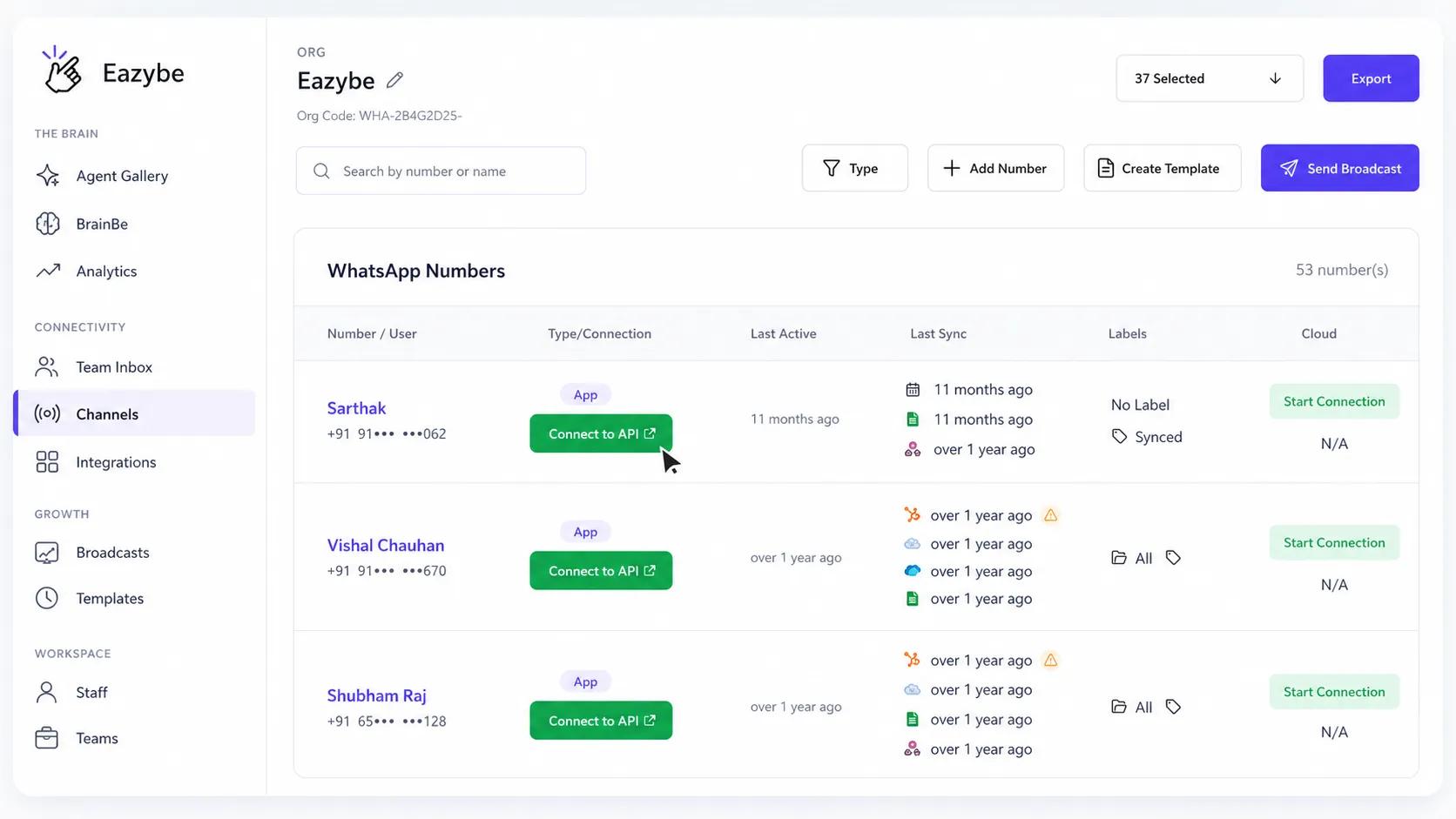
Connect your existing WhatsApp numbers to the API with one click in Eazybe
Your WhatsApp Coexistence setup is straightforward. Before you start make sure you have:
- An active WhatsApp Business App number with real chat history.
- A Meta Business Account.
- Admin access to the WhatsApp Business Account linked to that number.
The Coexistence setup runs through Meta's official process.The WhatsApp Coexistence documentation from Meta covers every eligibility rule and error code if you want the technical detail. You connect the number. You verify it. You choose whether to sync your chat history. The Business App keeps working the whole time. So, you never change your number and you never lose a chat.
Once the number is connected Eazybe adds the parts Meta does not give you:
- Chats and contacts and deals sync straight into your CRM.
- Follow ups get tracked so, no lead slips through.
- Response times and pending chats and team performance are all visible.
- Every conversation stays linked to the right customer and the right deal.
- Cloud backup keeps chats safe even if a rep leaves or loses their phone.
Your team keeps using WhatsApp the way they always have. You get the CRM visibility and the automation and the follow up management on top of it. If you already run HubSpot then every WhatsApp conversation lands against the right contact. Without anyone copying anything by hand.
How To Choose A WhatsApp Coexistence Provider
Meta WhatsApp Coexistence gives you the connection. Everything after that comes from your provider. A good Meta WA Coexistence provider should cover four things. Fast onboarding. Chat history sync. Two way message sync that never drops a message. Follow up tracking so hot leads do not go cold.
The best WhatsApp Coexistence provider depends on how your team sells. Reps on phones need CRM syncing and a shared inbox. Ad driven teams need AI agents and lead qualification.
Most top WhatsApp Coexistence provider options handle the connection. The difference is what happens after. Eazybe WhatsApp coexistence was built for teams selling on WhatsApp. So, the focus sits on follow ups and pipeline.
Who Should Use Coexistence And Who Should Skip It
The WhatsApp Coexistence feature is built for businesses already living on the WhatsApp Business App. Who now want automation and CRM syncing and the Cloud API without giving up their number. It is not the right fit for everyone.
Skip it if:
- Your WhatsApp Business number is brand new. Meta checks account history and messaging quality. Before approving coexistence a fresh number usually gets rejected.
- Your number is already on the WhatsApp Cloud API. Coexistence only works one way which is app to API and never the reverse.
- You need the Official Business Account blue badge. It is not supported on a coexistence number.
- Your business runs on pure automation. If nobody on your team chats from the WhatsApp Business App then the plain Cloud API is simpler and does the job.
If your business mixes human conversation with automation. Then coexistence is the best setup available. You get better customer communication without asking anyone to change how they work. That is what real sales enablement looks like on WhatsApp.
Common Mistakes To Avoid With WhatsApp Coexistence
Setting it up is only the first step. Most businesses lose value afterwards. Watch out for these:
- Trying to automate every conversation: Use AI for lead qualification and FAQs and follow ups. Leave negotiation and closing to your sales team. Customers can feel a bot in a sales conversation and it costs you deals.
- Not telling your team what changed: Disappearing messages and in app broadcast lists behave differently after coexistence is enabled. Reps who find out by accident assume the system is broken.
- Setting it up and keeping the old workflow: If your team still tracks follow ups from memory you have gained nothing. Use the reminders and the automation and the CRM properly.
- Not sending qualified lead data back to Meta: If you run Click to WhatsApp Ads then push the qualified lead events back. Otherwise you pay for clicks and Meta never learns which leads were any good.
- Ignoring the reports: Response times. Pending conversations. Follow ups. Team performance. WhatsApp sales performance analytics exist. So, you stop guessing and start fixing.
Avoid these five and coexistence actually pays for itself instead of sitting there as another connected tool nobody uses.
Final Thoughts On WhatsApp Coexistence Meta
WhatsApp Coexistence does not replace the Business App and it does not replace the Cloud API. It runs both on one number. Your team keeps chatting from their phones and from WhatsApp Web. While the API handles broadcasts and automation and AI and CRM syncing behind them.
The timing makes it matter more. From October 2026 Meta starts charging for 24 hour service messages sent through the API. Keep normal customer conversations on the Business App where they cost you nothing and use the API only for automation and campaigns. Your bill stays low and you lose none of the features.
Pair it with the right WhatsApp business tools and AI Agents and your follow ups run themselves. Managers finally see what is happening across the team. Sales gets easier to manage. WhatsApp stops being a chat app on someone's phone and starts working like a proper sales channel you can actually run.