
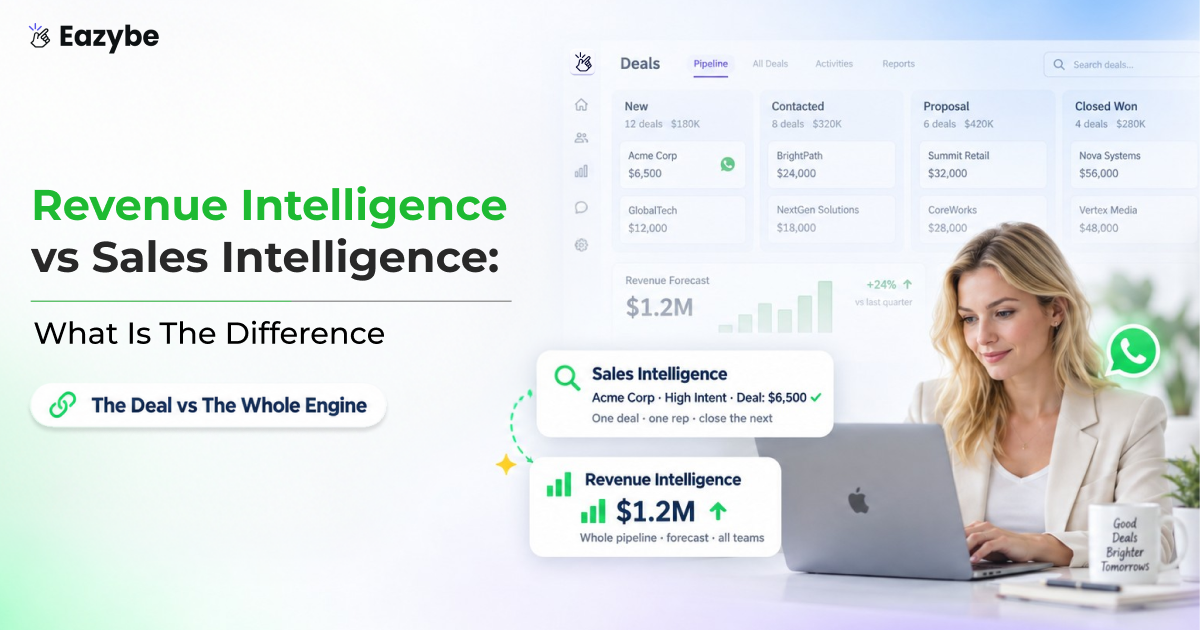


Sales intelligence reads one conversation and tells you what happened inside it. Revenue intelligence reads your whole pipeline and tells you whether the quarter is safe. Vendors sell them as the same thing. Which is how a buyer ends up in three demos looking at three different products under one label.
In this Eazybe blog, we explain what each term actually means, where conversation intelligence fits and which one your team should fix first. Eazybe AI agents read every WhatsApp conversation into structured properties. Which is the layer both of these run on.
Also Read: Best WhatsApp CRM Chrome Extensions Compared For Sales Teams
What Is Revenue Intelligence?
Revenue intelligence is the use of pipeline data to judge the health of your revenue: which deals are progressing, which are slipping, and whether the forecast is believable.
The word to hold onto is revenue. It works at the level of the whole pipeline, not one deal, and everything it produces is a comparison against pattern.
What it answers:
- Is the forecast real: or is it built on optimism nobody has tested.
- Which deals have stalled: measured against how deals normally move at that stage.
- Where revenue leaks: which stage quietly loses the most.
- Who is off pattern: which segment, territory or rep is behind and by how much.
Deal risk is the main output. When a revenue inbox scores the health of every open deal, that is revenue intelligence doing its job.
What Is Sales Intelligence?
Sales intelligence is the layer that reads individual conversations and turns them into structured data such as intent, objection, reply time and next step.
The scope is what separates it. Revenue intelligence looks across hundreds of deals, sales intelligence looks inside one.
What it answers:
- What did the buyer actually say: in their words, not the rep's summary.
- How interested are they: browsing, comparing, or ready to buy.
- What is blocking this: price, timing, a competitor, or a missing document.
- What do we owe them: the quote, the call, the follow up nobody wrote down.
Buying signals are the raw material here, and the full mechanics live in WhatsApp sales intelligence.
Sales Intelligence vs Sales Enablement?
These two get mixed up constantly, usually because both promise to help reps sell better. They do it at completely different moments:
- Sales enablement equips the rep: content, training, playbooks, the material they sell with.
- Sales intelligence informs the rep: what this specific buyer said and what to do next.
Sales Enablement teaches a rep how to handle an objection. Intelligence tells them which objection this buyer is about to raise.
Revenue Intelligence vs Sales Intelligence: The Real Difference

Pipeline data meets conversations
Both read your sales data, so on a feature page they look almost identical. The split shows up the moment you ask what each one is actually looking at.
| What you are comparing | Revenue intelligence | Sales intelligence |
|---|---|---|
| Looks at | The whole pipeline | One conversation |
| Answers | Is this deal at risk | Why is it at risk |
| Time frame | Weeks and quarters | This week |
| Built for | Leadership and revenue ops | Reps and their managers |
| Output | Forecast, deal risk, pipeline health | Intent, objection, reply time, next step |
| Data source | CRM records and stage movement | The conversation itself |
The line worth remembering: revenue intelligence gives you the symptom and sales intelligence gives you the cause. Your dashboard says a deal went quiet. Only the conversation shows the buyer asked for a discount nine days ago and nobody replied.
The dependency runs one way. Sales intelligence works fine on its own, while revenue intelligence built on records nobody updates is a well designed way of being wrong on schedule. A WhatsApp crm that fills itself is what prevents that.
Suggested Read: How To Increase Sales: What Successful Companies Are Doing Differently
Revenue Intelligence vs Conversation Intelligence: Where The Third Term Fits
The reason this term confuses people is that it describes a capability while the other two describe a job. Conversation intelligence is what the software can do. Sales and revenue intelligence are what you use it for:
- Conversation intelligence is the engine: it reads a call or a chat and pulls meaning out of it.
- Sales intelligence is that engine pointed at sales: the output lands on your records.
- Revenue intelligence is what those records add up to: across the whole pipeline.
Which means you never really choose between them. You choose a platform, and what it can read decides how far up that stack you get.
For the full category breakdown, including how call based tools differ from chat based ones, conversation intelligence covers it properly.
What Revenue Intelligence And Sales Intelligence Each Answer
The fastest way to tell these apart is to stop reading feature lists and start listing questions. Each one has a set it answers well, and a set it cannot touch:
1. Revenue Intelligence Use Cases:
- Forecast accuracy: whether the number going to the board survives contact with reality.
- Pipeline hygiene: which deals have not moved and should not be counted.
- Stage conversion: where deals reliably die and what that costs you.
- Segment performance: which parts of the business are ahead or behind.
2. Sales Intelligence Use Cases:
- Which chat to open first: out of forty this morning.
- What the objection really was: last time this buyer went quiet.
- Who is waiting on a reply: and for how long.
- What was promised: and whether it actually happened.
3. What Reps, Managers And Leadership Each Need:
- Reps need sales intelligence: their world is the next conversation.
- Leadership needs revenue intelligence: their world is the number.
- Managers need both: which is why rep radar is useful to them, turning individual reply times into a team pattern.
Also Read: Top 9 Best Sales Enablement Tools: Help Teams Manage Leads, Follow-Ups And Close Deals Faster
How Eazybe Turns Conversations Into Sales Intelligence
The theory is easy to agree with. The hard part is that someone has to read every conversation, and no team has the hours for it.
Eazybe hands that job to agents. It runs as a Chrome extension over WhatsApp Web on whichever number your reps already use, personal numbers included. Nothing migrates, no second app opens, and the selling looks the same from the rep's side. The only change is that the conversation now leaves a record.
That last part depends on WhatsApp coexistence, which runs the API alongside the app on the same number. Without it, the chats that decide your quarter stay invisible.
What Sales Intelligence Reads From A Conversation
Most tools only read typed messages, and that is where the gaps start:
| What | Why It Matters |
|---|---|
| The whole thread | A price question in March and a setup question in May read as progress, not two random messages |
| Voice notes | Budgets and deadlines get spoken far more often than typed |
| Attachments | Quotes stay findable instead of buried in a scroll |
| Personal numbers | Where the deals that matter usually sit |
The Sales Intelligence Properties Written To Each Contact

Intelligence written to contacts
Every conversation produces properties in three families:
- Analytics properties: the countable facts, such as who replied last, when, and how fast your team answers this buyer
- Engagement Intelligence properties: the meaning, covering intent, objection, urgency, heartbeat, escalation and next step
- Industry properties: your own business fields, filled from the buyer's words, such as budget and location for property
Property is the word doing the work. A saved chat is something you open and read. A property is something you can sort a thousand contacts by.
For a closer look at how intent and escalation are read, whatsapp buying signals covers that layer in detail.
Where Your Sales Intelligence Data Lands
- In your CRM: HubSpot, Zoho, Salesforce and the rest, as native fields in the views your team already uses
- Or inside Eazybe: for teams running a WhatsApp crm, with the same sorting and filtering
That is a storage choice, not an intelligence one. Start without a CRM, add one later, and the history follows.
What Automated Sales Intelligence Changes Day To Day
None of this is worth much if the week still runs the same way. Three things shift almost immediately, and none of them ask anyone to work differently.
- Reps stop retyping: the record fills from work they already did
- Managers stop asking: quiet deals and slow replies show up before Monday
- The data stops being memory: the buyer's words replace the rep's recollection
Reading is the floor, not the ceiling. Best AI sales agent takes it further, qualifying leads against your own catalogue and pricing before routing them to the right rep with the history attached.
How That Sales Intelligence Becomes Revenue Intelligence

Sales data becomes revenue insight
This is the bridge most explanations skip. Once every conversation carries properties, individual facts turn into a data set:
- One deal with a reply time is a fact: every deal carrying one is a pattern
- One quiet thread is an oversight: forty quiet threads is a pipeline problem
- One objection is a conversation: the same objection across twenty deals is a positioning problem
That aggregation is revenue intelligence, and it only works because the records underneath are accurate. Forecast accuracy is downstream of data quality, which is downstream of whether anyone updated the CRM. When properties write in automatically through something like a HubSpot WhatsApp integration, the forecast starts describing your business rather than your data entry habits.
Why You Need Sales Intelligence Before Revenue Intelligence
Revenue intelligence is analysis sitting on top of CRM records. If those records are stale or written from memory at six in the evening, the analysis inherits every flaw and presents it with a confident chart attached.
Put simply:
- Bad input, confident output: you get a wrong answer faster and at scale
- Sales intelligence fixes the input: the record reflects what was actually said
- Everything downstream improves: every pipeline view built on it starts from something true
Buying pipeline analytics before fixing conversation capture is buying a better lens for a camera with no film in it. Teams usually notice the difference in their reporting first, which WhatsApp sales performance analytics covers in detail.
The Benefits Of Running Sales Intelligence And Revenue Intelligence Together
Separately they each solve half a problem. Run both and you get things neither one can give you on its own:
- The forecast stops surprising you: risk is flagged from behaviour rather than from a rep's stage guess.
- Deals get rescued while alive: a slipping conversation surfaces in days, not at month end.
- Reps open the right chat first: effort goes where the movement is.
- Coaching runs on evidence: the manager opens the conversation instead of asking what happened.
- CRM entry stops being a chore: the record fills from work the rep already did.
- Patterns become visible: a recurring objection becomes a positioning fix rather than twenty separate losses.
The rep facing half of that is where a WhatsApp copilot earns its place, drafting the reply while a person decides whether it goes out.
Why Revenue Intelligence And Sales Intelligence Merge On WhatsApp

Revenue Intelligence And Sales Intelligence Merge On WhatsApp
On most channels these stay cleanly separate, because the conversation lives in one system and the pipeline in another. WhatsApp collapses that:
- The chat is the evidence: it is where the buyer said what they want.
- The chat is also the input: it decides whether the deal record is accurate.
- So there is no CRM entry in between: conversation data and CRM hygiene stop being two problems.
That is why teams selling here feel the gap so sharply. The deals move somewhere the pipeline cannot see, so the forecast runs on whatever reps remembered to mention. Once every chat lands in a shared WhatsApp team inbox with properties attached, the conversation and the pipeline finally describe the same reality.
Revenue Intelligence vs Sales Intelligence: Which One Is Better
This is the question every buyer eventually asks, and the honest answer is that neither is better. They solve different problems, so asking which wins usually means. You have not yet decided which problem you have:
- Revenue intelligence is better if: your records are clean and the forecast still misses, which points at analysis.
- Sales intelligence is better if: the forecast misses because nobody knows what happened in the conversations.
The second is far more common. The honest test is one question: can you say which deals went quiet last week without asking anybody? If not, more analytics will not help. Because the gap is in what your system knows. Rather than how it presents it.
Do You Need Revenue Intelligence Or Sales Intelligence: Which Fits Your Team
The right answer depends less on your ambition than on what your team already has in place. Three situations cover most companies, and each one has a clear starting point:
- Small team on WhatsApp with no CRM: sales intelligence, easily. You need conversations turned into something sortable before pipeline analysis means anything, and the properties can sit in Eazybe until a CRM earns its cost.
- Growing team with a CRM nobody updates: sales intelligence first, revenue intelligence on top. You already own the pipeline tooling and the data underneath is the problem.
- Larger team with clean data and a forecast problem: revenue intelligence, with sales intelligence covering whichever channel your current tools cannot read.
If you are past definitions and shopping for tools, the top revenue intelligence platforms roundup compares what each one actually sees.
Honest Limits Of Revenue Intelligence And Sales Intelligence
Both categories are sold with more confidence than they deserve. Five things worth knowing before you build a process on either:
- Revenue intelligence cannot fix bad inputs: it reads what your CRM holds, so incomplete records give you a confident wrong picture.
- Sales intelligence reads, it does not decide: intent and escalation are prompts for a person, and the rep still makes the call.
- Thin conversations give thin output: a four word thread tells any system almost nothing.
- Neither one closes a deal: both decide where attention goes, and someone still has to reply.
- Channel coverage decides everything: a tool that cannot read your channel is measuring half your business, which is why coexistence matters for teams on personal numbers.
Must Read: WhatsApp Sales Funnel: How To Manage Leads, Follow-Ups And Closings In One Chat
Final Verdict: Difference Between Revenue Intelligence vs Sales Intelligence
Revenue intelligence and sales intelligence are not rivals, they are two ends of the same chain. The conversation produces the signal, the signal fills the record, and the records add up to a picture of your pipeline. Break the first link and everything after it is guesswork wearing a dashboard.
If you are deciding where to start, start where the data is created rather than where it is displayed. Get the conversations reading into properties and the pipeline view you have been trying to build becomes one you can actually trust.