


What Is WhatsApp Lead Qualification?
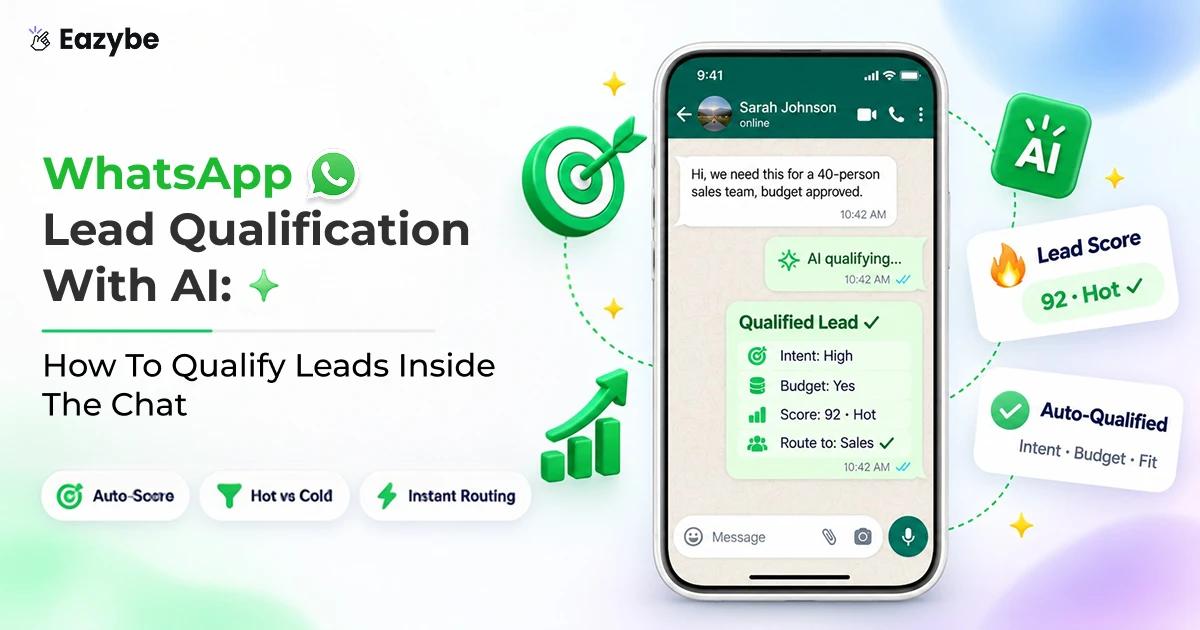
WhatsApp lead qualification is the process of judging how serious a lead is from the conversation itself, using signals such as budget, timeline and question specificity, rather than from a form or a discovery call.
Traditional qualification is about collecting new information. This is about reading what the buyer already gave you. Which turns the job from asking into noticing.
Three things have to happen for it to be worth anything:
- The signals have to be pulled out of the thread instead of sitting there unread.
- They have to become fields you can filter and sort on.
- The scored lead has to reach someone who can act on it.
Get the first two right and skip the third, and all you have built is a very sophisticated way of doing nothing.
Also Read: WhatsApp Chatbot Builder: From Simple Bots To Smart Customer Journeys
Why Lead Qualification Without A Form Works Better On WhatsApp?
The standard playbook sends a lead to a form. On WhatsApp that breaks immediately and it is worth being honest about why:
- A form is a worse experience than the chat: Someone already messaging you is being asked to stop, open a browser, and retype what they just said.
- Drop off is brutal: Every step between a warm message and a qualified lead costs you a share of them.
- The answers are worse anyway: People tick a budget range on a form and describe their real budget in a chat.
- It kills the moment: By the time the form comes back, the buyer who was ready to talk has moved on.
The alternative is letting the conversation do the qualifying, with a shared team inbox making it visible to more than one person.
The Signals That Qualify Leads On WhatsApp

Budget, timeline, intent detected
Most of what a buyer sends you is noise, and a small part of it tells you everything. These are the lines worth reading closely.
Budget, Authority, Need And Timing On WhatsApp
BANT still works, it just arrives differently here:
- Budget: a stated number, a question about payment terms, or anything about financing.
- Authority: lines like "I need to check with my partner" or "our team decided", which tell you who signs.
- Need: how specific the product question is, since browsers ask general questions and buyers ask precise ones.
- Timing: any mention of a date, a deadline, a possession window or a renewal.
None of that needs a discovery call. It arrives unprompted in the first few exchanges, which is the underrated advantage of the channel and something WhatsApp sales intelligence covers across a full pipeline.
The Signals BANT Misses
Three more predict outcomes at least as well:
- Reply speed: Someone answering in two minutes is in a different state of mind from someone answering in two days.
- Question depth: "Do you have it in blue" is a browser. "What happens if I cancel in month three" is a buyer.
- Who is chasing whom? A lead following up on your message is worth more than any form field.
Suggested Read: How To Improve Sales Efficiency With Better WhatsApp Tracking
What Eazybe AI Agents Read For AI Lead Qualification
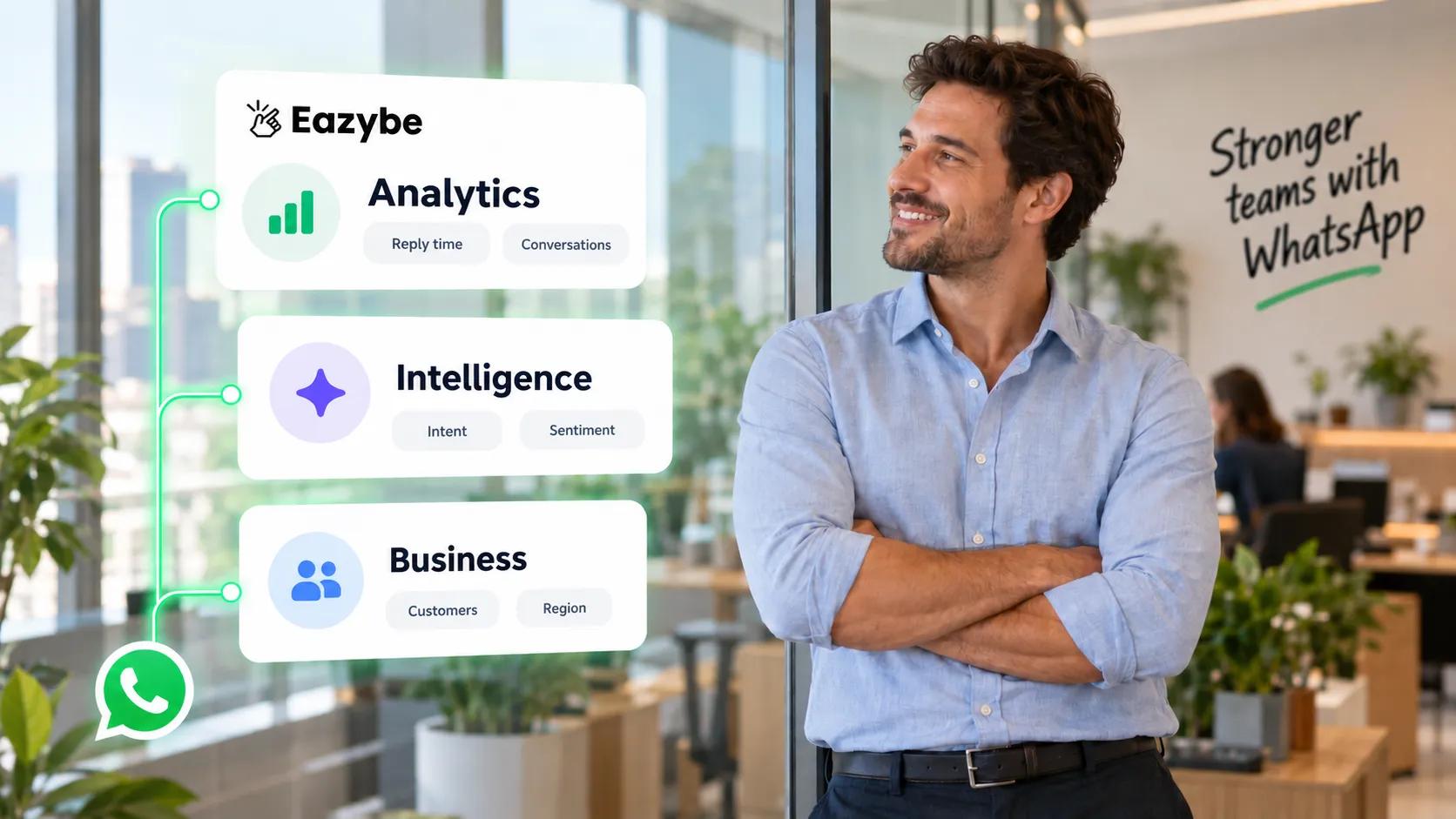
What AI agents analyze
This is the mechanism underneath everything above. Instead of a rep summarising a chat, Eazybe AI agents read each conversation and write what they find onto the contact as properties. Those come in three families.
Analytics Properties: The Countable Facts
Measured rather than interpreted, so there is nothing to second guess:
- Who sent the last message, separating chats waiting on you from chats waiting on them.
- When it was sent, so aging conversations surface on their own.
- Average response time on that specific contact.
- Message counts each way, showing effort against engagement.
Engagement Intelligence: Intent, Heartbeat And Next Steps
Counting shows the shape of a conversation. Reading it shows the direction:
- Intent: separating browsing from comparing from ready to buy.
- Heartbeat: telling you whether a quiet deal is actually dead.
- Escalation: catching a complaint while someone can still fix it.
- Next steps: pulling out the quote, call or document you owe.
- Task to create: turning that into something with a deadline.
Industry Properties: The Fields Your Vertical Runs On
This family removes data entry rather than reducing it. The AI pulls business facts out of what was already said, and the fields follow whatever you sell: listing, budget and location for property, appointment type and urgency for a clinic, policy type for insurance.
An ai sales agent goes one step further, qualifying against your own products and pricing and then handing the lead to the right rep with the full history attached.
Also Read: Top 9 Best WhatsApp Business Tools for Sales, Support & AI Automation
How WhatsApp Lead Scoring Works

Hot, warm, cold leads
Signals tell you a lead is interesting, but they do not tell you which of thirty interesting leads to open first. Scoring is what settles that.
Lead Scoring Criteria Worth Using
Weight these five and you will be close enough:
- Stated budget or a payment question, the strongest single signal there is.
- A named timeline, since anything with a date beats anything without.
- Product specificity, because precise questions mean a shortlist.
- Response speed, which shows active consideration.
- Who sent the last message, as inbound follow up is intent you did not manufacture.
What Makes A High Intent Lead
A high intent lead usually shows three of those five at once, and nearly always includes a timeline. Watch for a buyer who names a date and asks a precise question in the same message, because that pairing almost never appears in casual browsing.
Scoring also gives you something to coach against. Once leads carry a score, rep radar tells you whether your best leads are being answered fastest or sitting behind older ones.
Must Read: Top 5 WhatsApp Automation Tools: Features, Benefits And Pricing Etc
How A Qualified Lead Reaches Your WhatsApp CRM

Qualified leads auto-assigned instantly
Qualification with no routing behind it changes nothing at all. This last step is the one that matters:
- Properties write into the CRM automatically, landing on the contact or deal rather than staying in a chat.
- The lead routes to an owner, either the existing contact owner or the next free rep.
- A hot lead gets flagged on arrival, so it does not queue behind colder work.
- The full history travels with it. So, whoever picks it up is not starting cold.
A HubSpot WhatsApp integration is the most common version, with Zoho, Salesforce, Pipedrive and Bitrix24 working the same way. With no CRM at all, the properties simply stay in Eazybe and you sort and filter on them there.
How To Qualify Leads On WhatsApp Step By Step
Getting this running takes an afternoon rather than a rollout plan. Six steps and the last one is the one people skip:
- Connect your WhatsApp number using personal WhatsApp, the Business App, or the API through coexistence, with no migration and no number change.
- Choose the properties that matter to your pipeline, such as budget, timeline, product interest and region, so the AI writes only what you will use.
- Let the AI read your conversations, including existing history, so scoring starts from real data rather than an empty slate.
- Set your scoring weights against the five criteria above, adjusted for how your buyers actually behave.
- Configure routing so a qualified lead lands with an owner immediately instead of waiting to be assigned.
- Review the first week manually. Check the AI's reads against your own judgement on twenty deals, then adjust before trusting it at volume.
Also Read: What Is Sales Enablement? A Complete Guidebook For Businesses
WhatsApp Lead Qualification Questions Worth Asking
AI reads what is said, so a better question produces a better read. These four qualify without feeling like an interrogation:
- "What timeline are you working to?" surfaces urgency in one line.
- "Is this for you, or are you looking for someone?" finds the decision maker without asking who the decision maker is.
- "What have you looked at so far?" reveals whether you are on a shortlist or at the start.
- "What would need to be true for this to work?" pulls out budget and objection together.
Sent as an opener at scale, these work best as an approved message template, since anything outbound beyond the 24 hour window needs one.
Honest Limits Of AI Lead Qualification
AI reads conversations well and it does not read minds. Five things worth knowing before you build a process around the score:
- A short thread gives the AI very little: Three messages of "
hi", "price?" and "ok" cannot be scored meaningfully, and no system changes that. - An unqualified lead is not always a dead one: Someone browsing today may buy next quarter, so treat a low score as an ordering decision rather than a verdict.
- AI reads intent, it does not confirm it: The properties point a rep at the right conversation, and the rep still decides.
- Scoring reflects your inputs: Wrong weights produce a confidently wrong ranking, which is why that first week of review matters.
- It does not fix a slow team: Perfect qualification with a four hour response time still loses to a competitor who replied in ten, which is what a revenue inbox view exists to prevent.
Suggested Read: WhatsApp HubSpot Reporting For Clear Sales Performance Visibility
Final Verdict: WhatsApp Lead Qualification Bot
The uncomfortable truth about lead qualification on WhatsApp is that it already happened. Your buyers named their budget, their timeline and their real objection, and all of it went into a thread nobody read back.
Reading those conversations into properties, scoring them, and routing the result is a far smaller change than building a qualification process from scratch. Better still, it works with how your reps already sell rather than against it.
Ready to see which of your chats are actually qualified? Start with Eazybe