
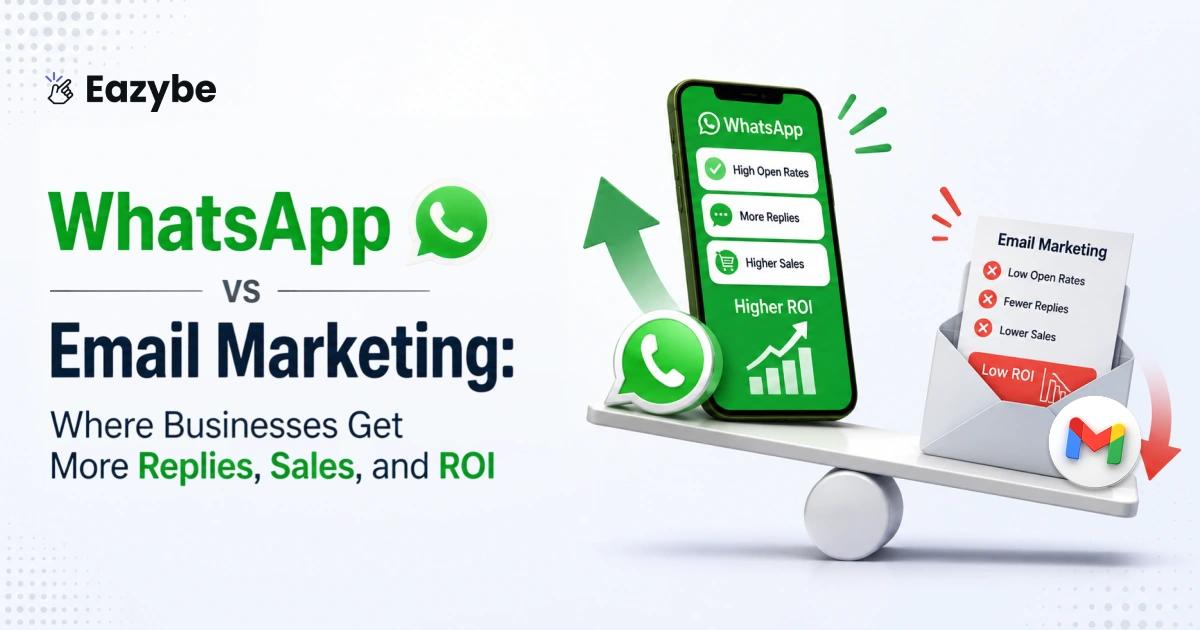


WhatsApp vs Email marketing is a question most businesses are asking now and for good reason. Both channels work, but WhatsApp messages are read within minutes while emails sit unread for hours. WhatsApp open rates hit 95–98%, response rates reach 30–60%, and there's no spam folder. Email's true open rate? Closer to 20–25% after adjusting for inbox noise.
That's why smart brands now use WhatsApp for quick replies, follow-ups, and closing deals while email handles newsletters and formal updates. Eazybe - WhatsApp AI Agent With CRM integration make it even easier, helping businesses manage WhatsApp conversations at scale without missing a single chat.
What Is Email Marketing And WhatsApp Marketing?
If you ever got a "your order is confirmed" message on WhatsApp or a weekly deal email from a brand you follow, you have already seen both in action.
Email marketing has been around forever. Businesses send newsletters, promotions and updates straight to your inbox. It still works for a lot of things. But the problem today is that everyone's inbox is a mess. Offers, spam, reminders, most of it never gets opened.
WhatsApp marketing is where things have shifted. People use WhatsApp all day to talk to people they actually know. So when a brand show up there with something useful, a discount and a delivery update or a quick followup with whatsapp crm it does not feel like marketing. It feels like a real message. That is why WhatsApp marketing gets opened nearly every time while most marketing emails don't even get a second look.
In the email vs WhatsApp marketing debate it is not really about which one is better. It is about where your customer is actually paying attention and right now that place is WhatsApp.
WhatsApp vs Email Marketing: Key Metrics Compared
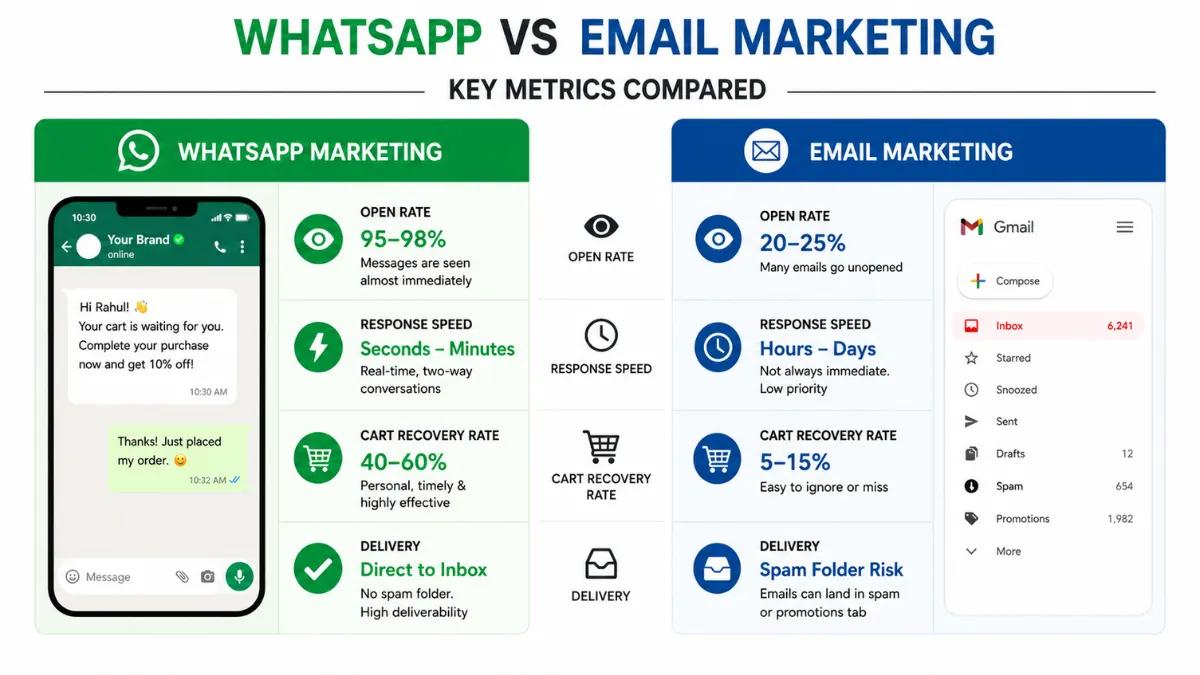
Numbers don't lie. When you put WhatsApp vs email marketing side by side the difference is pretty hard to ignore.
WhatsApp open rates sit around 95 to 98 percent. Email open rates in reality are closer to 20 to 25 percent and even that number is inflated because Apple Mail automatically marks emails as opened before anyone actually reads them. So the real number is probably lower.
Click through rates tell the same story. WhatsApp engagement rate on a good campaign goes up to 45 to 60 percent and whatsapp copilot does faster deals. Email CTR averages around 2 to 3 percent. That is not a small gap.
Then there is deliverability. WhatsApp has no spam folder. Every message reaches the person. With email one in six marketing messages never even makes it to the inbox.
Here is a simple look at how both channels compare:
| Feature | WhatsApp Marketing | Email Marketing |
|---|---|---|
| Open Rate | 95 to 98 percent | 20 to 25 percent |
| Click Through Rate | 45 to 60 percent | 2 to 3 percent |
| Response Rate | 30 to 60 percent | 5 to 10 percent |
| Response Time | Within minutes | 12 plus hours |
| Spam Folder Risk | None | 1 in 6 emails blocked |
| Best For | Conversions and follow ups | Newsletters and B2B |
When you look at this WhatsApp vs email marketing comparison the engagement gap is clear. WhatsApp just gets more attention and that attention turns into more replies, more clicks and more sales.
Why WhatsApp Gets Faster Replies Than Email
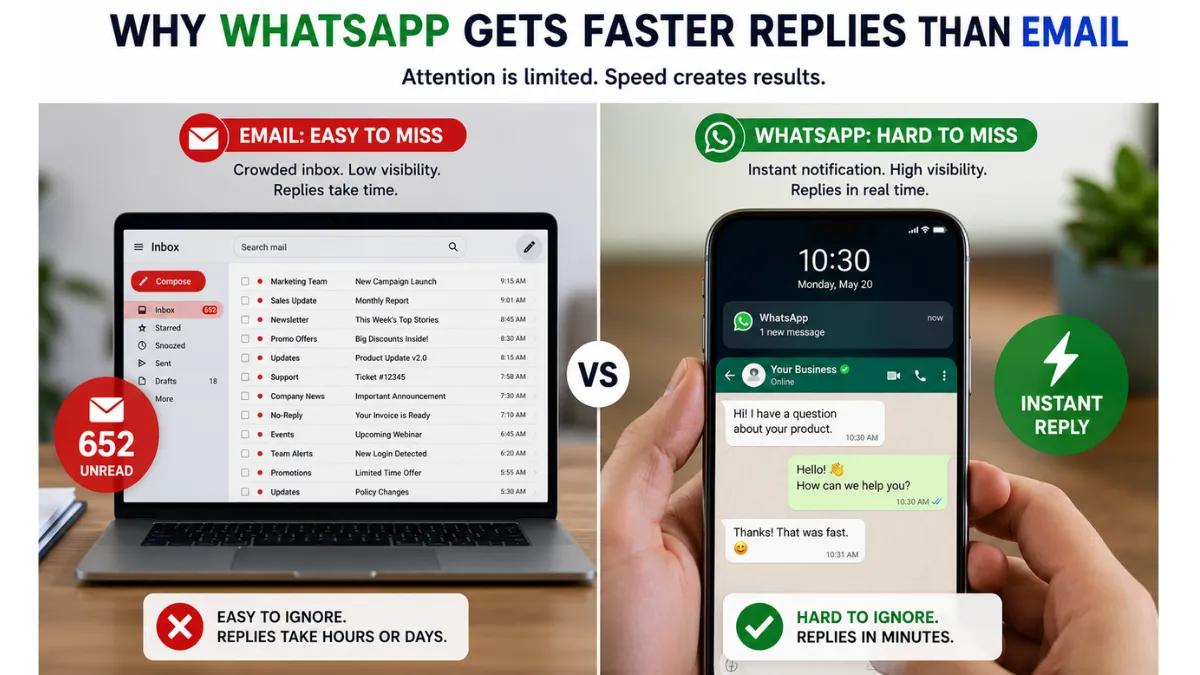
Think about the last time you got a WhatsApp message. You checked it within minutes. Now think about the last marketing email you got. It is probably still sitting there unread.
That is the real difference and it has nothing to do with design or copywriting. It is simply about where people pay attention.
Here is why WhatsApp response rate is so much higher than email:
- It feels personal: WhatsApp is where people talk to friends and family. When a brand message lands there it does not feel like an ad. It feels like a real conversation.
- The notification is hard to ignore: A WhatsApp ping on your phone screen is very different from an email sitting in a crowded inbox team with 50 other unread message.
- Replying is effortless: No logging in, no scrolling, no "I will read this later." The message is short, it is right there and replying takes five seconds.
- There is no spam folder: Every message reaches the person. With email one in six never even makes it to the inbox.
- The numbers show it clearly: WhatsApp response rate sits between 30 to 60 percent. Email response rate on a good day is around 5 to 10 percent.
That is what instant messaging marketing does differently. It removes all the friction between your message and your customer and that is exactly why conversational marketing on WhatsApp gets results that email simply cannot match.
Why Email Marketing Still Matters For Businesses
WhatsApp is fast but email still has its place. Not every message needs to be instant.
Here is where email still works:
- B2B communication: Corporate clients and business teams still prefer email for formal conversations. It feels professional and keeps everything on record.
- Newsletter marketing: Long updates, guides, industry news, email is the right place for all of it. WhatsApp is not built for long content.
- Big lists, low cost: Sending to thousands of people costs almost nothing with email. For general announcements it is still the most affordable option.
- Documents and records: Invoices, proposals, contracts, anything that needs to be saved and referred back to belongs in email.
That said businesses today are combining email with AI agents for customer support. Email handles the formal side while Eazybe AI agents take care of real time customer questions on WhatsApp. So customers get instant replies instead of waiting hours for an email response.
Email sets the foundation. AI agents and WhatsApp keep the conversation going.
WhatsApp Marketing Advantages For Sales And Conversions
When it comes to sales enablement WhatsApp just works better than email. Here is why:
- Conversations happen instantly: A customer asks something, gets a reply in seconds and makes a decision. No waiting, no back and forth over email.
- WhatsApp lead generation is faster: Leads coming through WhatsApp convert 3 to 5 times more than email or web form leads. The conversation starts right away and that makes all the difference.
- Abandoned carts get recovered.: A WhatsApp message sent within 30 minutes of someone leaving their cart recovers 25 to 40 percent of those sales. Email barely manages 5 to 11 percent.
- WhatsApp automation saves time: Follow ups, order confirmations, reminders, all of it runs automatically with whatsapp automation without anyone sending messages manually.
- Flash sales actually land: A WhatsApp message reaches 95 to 98 percent of your list right away. By the time the same offer hits an email inbox the sale is usually already over.
The WhatsApp sales tracking funnel works because everything happens in one place. Good sales enablement is about removing friction between your product and your customer and WhatsApp does exactly that.
WhatsApp vs Email ROI: What The Data Says
Everyone wants to know which one actually makes more money. Here is what the numbers say. Email marketing statistics show a return of around 36 to 42 dollars for every 1 dollar spent. That is consistent and has been working for years.
WhatsApp ROI pricing goes further though. Businesses running WhatsApp campaigns report returns of 15x to 60x. Some have even crossed 100x on time sensitive offers. When 95 to 98 percent of your messages get opened that kind of return starts to make sense.
Here is a simple marketing ROI comparison:
| Metric | ||
|---|---|---|
| Open Rate | 95 to 98 percent | 20 to 25 percent |
| Click Through Rate | 45 to 60 percent | 2 to 3 percent |
| Cart Recovery Rate | 25 to 40 percent | 5 to 11 percent |
| Average ROI | 15x to 60x | 36x per dollar spent |
Both channels make money. WhatsApp wins when you need fast results. Email wins when you are sending to a large list at low cost. The best approach is using email to reach people and WhatsApp to convert them.
Best Tools For WhatsApp Marketing
There are a lot of WhatsApp marketing tools out there. Here are the ones people are actually using.
- Eazybe: works right inside Chrome on top of WhatsApp Web. If your team already uses WhatsApp Web all day this one just fits in without any extra setup. The WhatsApp coexistence feature is genuinely useful, multiple team members can manage conversations from one number without stepping on each other.
- AiSensy: is what a lot of e-commerce brands use for sending bulk campaigns. Good if you need to reach a large list fast.
- Interakt: is popular with small and mid size businesses in India. Mostly used for sending order updates, notifications and basic customer support on WhatsApp.
- Wati: is straightforward. Shared inbox, basic automation, nothing too complicated. Works well for smaller teams.
- Respond.io: is more for businesses handling conversations across multiple channels at once. WhatsApp is one of them.
- Gallabox: is a decent option if you want automation without spending too much time on setup.
- Zoko: is mostly used by e-commerce brands that want to handle both WhatsApp campaign and order management in one place.
Every tool has its own strengths. The best one is really the one that fits how your team already work.
Why Use WhatsApp Instead Of Email?
If you want faster replies and real conversations WhatsApp is the better choice. Here is why. It feels personal. A WhatsApp message feels like it is coming from a real person not a brand sending bulk emails.
It is faster. People check WhatsApp all day. No inbox clutter, no promotions tab, no waiting. It is interactive. Images, videos, voice notes, buttons, everything happens in one chat without the customer going anywhere else.
It builds trust. A quick reply on WhatsApp sales performance analytics makes customers feel heard. That is something email marketing rarely manages to do.
WhatsApp vs email marketing comes down to one thing. People are simply more present on WhatsApp Copilot and that is where action happens faster.
Advantages Of WhatsApp Marketing
WhatsApp is not just a messaging app anymore. For businesses it has become one of the most effective ways to reach and convert customers. Here is why.
- Messages actually get read: Most people open a WhatsApp message within minutes. Open rates sit at 95 to 98 percent. Email simply cannot match that.
- No spam folder: Every message lands directly with the customer. No algorithm, no promotions tab, no guessing whether your message got through.
- Conversations feel real: WhatsApp marketing does not feel like marketing. It feels like a chat and that makes customers more comfortable and more likely to reply.
- It works for everything: Discounts, order confirmations, lead follow ups, customer support. All of it happens in one place without switching between tools.
- Automation saves time: Follow ups, reminders, replies. WhatsApp automation tools handle all of it automatically so your team does not have to send every message manually.
- WhatsApp coexistence makes teamwork easier: Multiple team members can manage conversations from one number at the same time without missing a single chat.
- It drives real sales: Businesses using WhatsApp for abandoned cart recovery get back 25 to 40 percent of lost sales. That number directly affects revenue.
- Customers trust it more: A quick reply on WhatsApp makes people feel like a real person is there. That trust is what turns a conversation into a sale.
Disadvantages Of WhatsApp Marketing And How To Fix Them
WhatsApp marketing works well but it comes with a few challenges. Here is what to watch out for and how to handle it.
- Too many chats at once: When hundreds of messages come in at the same time one person cannot manage it all. Chats get missed and customers get frustrated.
Fix: A shared team inbox lets multiple people handle conversations from one number. Businesses using this see up to 54 percent less workload on their support team.
- Template approval takes time: Every WhatsApp marketing message needs Meta approval before sending. For new businesses this feels like an extra hurdle.
Fix: Keep templates short and useful. Simple messages get approved faster. No hard selling in the copy.
- People opting out: Too many messages or irrelevant ones and customers will block you. Once they opt out they rarely come back.
Fix: Only send what customers actually care about. Businesses that do this keep opt out rates below 2 percent.
- It costs more than email: WhatsApp charges per conversation. Email costs almost nothing at scale.
Fix: Use WhatsApp for high intent customers where a sale is likely. Use email for broad low urgency communication. Email gives 36 to 42 dollars ROI per dollar spent. WhatsApp gives 15x to 60x on direct campaigns. Both together work better than either alone.
- Hard to scale support: As the business grows and handling every chat manually is not possible.
Fix: Automation handles the common stuff. Order update, FAQs, reminders. Businesses using Ai sales agent resolve 60 to 80 percent of queries without any human involvement.
Advantages Of Email Marketing
Email marketing has been around for decades and still delivers. Here is where it genuinely works well.
- Works really well for B2B: Corporate clients and business teams still prefer email for formal communication. Around 61 percent of B2B buyers say email is their preferred channel for brand communication. For proposals, invoices and contracts email is still the right place.
- Great for newsletters and long form content: Weekly updates, industry news, detailed guides. Email gives you the space to send all of it properly. Segmented email campaign generate 30 percent more opens and 50 percent higher click through rates than unsegmented ones.
- Cheap at scale: Sending to a large list costs almost nothing per message. Email delivers 36 to 42 dollars return for every 1 dollar spent. For broad low urgency communication the cost advantage is hard to beat.
- Keeps everything on record: Anything that needs to be saved and referred back to belongs in email. It is professional, documented and easy to track.
Disadvantages Of Email Marketing
Email still works but it has some real problems that businesses cannot ignore anymore.
- Most emails never get opened: The real open rate after adjusting for Apple Mail Privacy Protection inflation sits at 20 to 25 percent. That means 3 out of 4 people never even see your message.
- The spam folder kills your reach: One in six marketing emails never reaches the inbox at all. No matter how good your message is and if it lands in spam it is wasted.
- Response time is too slow: The average email response time is around 12 hours. For follow ups, lead conversion and cart recovery that wait costs real money.
- Open rate data cannot be trusted: Apple Mail automatically marks emails as opened before anyone reads them. So the numbers on your dashboard are not showing you the real picture.
How Smart Brands Use WhatsApp and Email Together
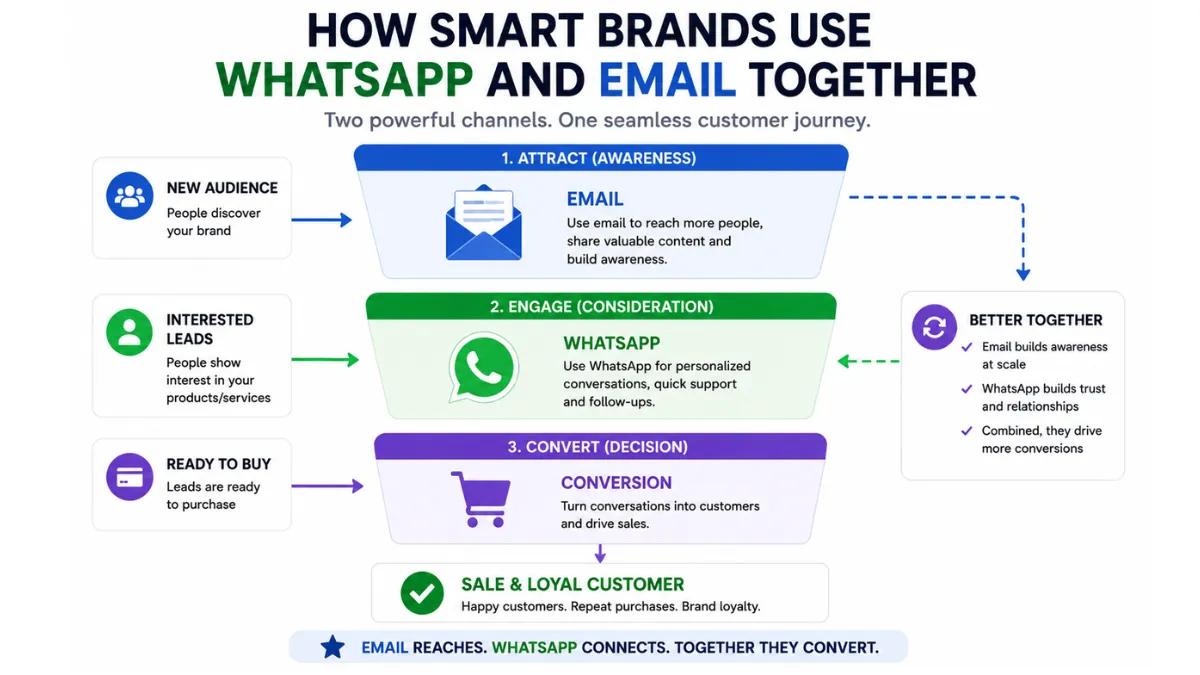
The smartest brands do not choose between WhatsApp and email. They use both and they use each one for what it is actually good at.
This is what omnichannel marketing look like in practice. Not just being on multiple channels but connecting them with whatsapp team inbox in a way that makes sense for the customer journey.
Here is how it works in real life
- Awareness stage: A customer finds your brand through an ad or a Google search. They sign up for your newsletter. Email takes over here. You send them useful content, product information and brand updates. This is where email nurtures the relationship.
- Consideration stage: The customer is interested but has not bought yet. This is where multichannel communication comes in. A follow up on WhatsApp feels personal and gets a reply much faster than another email would. WhatsApp response rates sit at 30 to 60 percent compared to email's 5 to 10 percent.
- Conversion stage: The customer is ready to buy or nearly ready. WhatsApp closes this gap fast. A quick message and a limited offer or a simple reminder about an abandoned cart recovers 25 to 40 percent of lost sales efficiency.
- Retention stage: After the purchase email handles the long form stuff. Loyalty updates, newsletters, product guides. WhatsApp handles the quick stuff. Delivery updates, reorder reminders, support questions.
The customer journey marketing approach that works best in 2024 is simple. Email builds awareness and nurtures. WhatsApp converts and retains. Together they cover every stage of the journey without any gaps.
Final Thoughts: WhatsApp vs Email Marketing
WhatsApp vs email marketing is not really a competition. Both work. They just work for different things.
Email is good for newsletters, formal communication and reaching a large audience at low cost. It has been doing that job for years and still does it well.
WhatsApp chat sync is where real conversations happen. Quick replies, follow ups, abandoned cart recovery, closing deals. People are present there and that is where action happens faster.
The businesses getting the best results are not picking one over the other. They use email to build awareness and WhatsApp to convert. Email to nurture and WhatsApp to close.
If you are only on email you are leaving a lot of sales on the table. If you are only on WhatsApp you are missing the reach email provides.
Use both. Know what each one is good at. That is what actually works.